
Together, art and science help us to interpret, study and explore the world around us.
Examining this ongoing relationship, The Art of Innovation: From Enlightenment to Dark Matter looks at the interaction between scientific progress and social change, how machinery has both influenced and threatened the human body and how tools that go beyond human senses can capture the unseen.
https://www.sciencemuseum.org.uk/see-and-do/art-innovation-enlightenment-dark-matter [accessed 1/12/19]
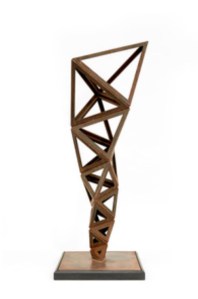
As you enter the exhibition you see a sculpture by Conrad Shawcross called Paradigm, a scaled down version of his original model commissioned by the Sir Francis Crick Institute.
Commissioned by the Francis Crick Institute and funded by the Wellcome Trust, Paradigm, by artist Conrad Shawcross, is one of the tallest public sculptures in central London. At an imposing 14 metres, it comprises of a twisting stack of tetrahedra that grow in size. The work is a feat of engineering and continues the artist’s long-standing collaboration with structural engineering practice Structure Workshop.
Thomas Kuhn’s theory of the ‘paradigm shift’ provided a starting point for Shawcross’ work for the Crick. Kuhn, an American philosopher of science, believed that scientific advancement does not progress in a seamless linear fashion, but rather through massive shifts that lead to breakthroughs, which change the course of thought, comprehension and application.
https://www.crick.ac.uk/about-us/our-history/our-building/paradigm [accessed 27/11/19]
The exhibition was divided up into four sections: Sociable Science, Human Machines, Troubled Horizons, Meaningful Matter.
Sociable Science
This section covered the earlier scientific discoveries which affected both the scientific community, and society. A painting depicting a lecture being delivered to a mixed group using an Orrery by Joseph Wright of Derby was prominently displayed.
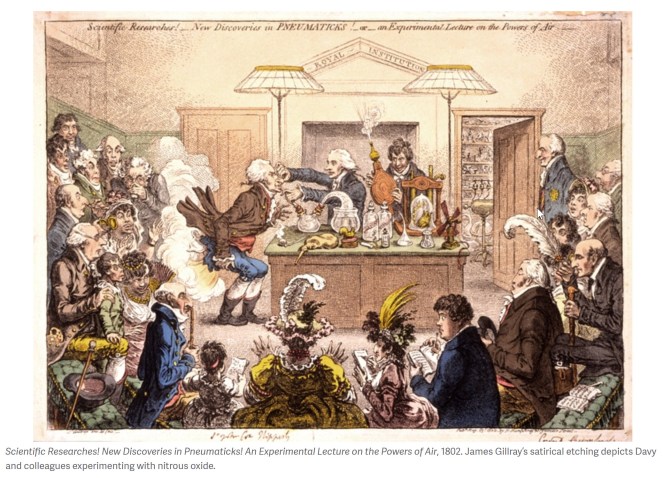
In this area we learnt about David Humphrey and his experiments with Nitrous Oxide, complete with the sceptics. Many people thought this was all “hot air”, hence the proliferation of cartoons relating to it. A cartoon by James Gillray depicting a lecture being delivered by Humphrey on the merits of Nitrous Oxide was on display.
At that time dyes were being developed, particularly in use by architect and textile designer Charles Francis Annesly Voysey. At the time mauve became very popular, but unfortunately tended to fade. It became so popular, that “ladies of ill reput” were frequently seen wearing this colour. Hence the quotation from Dorian Grey (Oscar Wild): “Never trust a woman in purple”.
Human Machines
This section covered machines which have had an impact on the artistic world. Prosthetic limbs and artistic images of those with the limbs, Eadweard Muygridge’s work with movement, particularly the horse.


Muybridge’s Zoopraxiescope used to create pictures of moving animals when researching movement.

Muybridge’s moving horse
At the same time, in France Etienne-Joules Marey was working on capturing movement in images.

Troubled Horizons and Meaningful Matter
This section focussed on the changes and the effects on the environment as a result of man’s technology. Although much of the work on display related to earlier in the 20th century, it is still current.
The exhibition was very well curated and yet again reinforced the fact that science and art can work together to explore and develop new artifacts and technologies.
 Context and Narrative