Part 2 · Uncategorized

Personal Stories

Peter Mansell, Dewald Botha and Jodie Taylor: the three examples of their personal stories are very different, but all have one thing in common: without a narrative they would appear very mundane to the viewer.

I was unable to view all the images created by Jodie Taylor, except the image of the garage block, but was able to get a feel for the type of images she had created as she returned to her childhood locations.

I didn’t feel that the set of images created by Dewald Botha in the Ring Road portrayed exactly how he felt.  He said that he started out the project “as an exploration of a physical object”, but over time the project became more personal, and developed into a “metaphor for distance placed and personal limits reached”.  Simply viewing his images would not have given me an understanding of this development had I not read his narrative accompanying the images.

The project which resonated with me most was that of Peter Mansell.  I am not a paraplegic, and thankfully I am now fit and active.  However, this was not always the case, as I grew up a chronic asthmatic in the days before the new generation on inhalers.  I now lead an active life due to the medication, not because I have “grown out” of asthma.  When I was young I was crippled by the desease, at a time when not much was known about it.  When I managed to get to school, which was rare, I was bullied because the other children thought I had an infectious desease.  As I write this I realise how much of my childhood I have chosen to forget, and this is bringing it back.  Peter Mansell said he could write about his experiences, or create pictures, but “in doing so, the reader or viewer would have to rely wholly on my imagination and abilities of expression”. He felt that using photography as the medium there is “a direct relationship with reality at its centre”.

In the past I have tried writing about my childhood experiences without success, but perhaps I will think about Peter Mansell’s approach to exploring his disability and consider photography as the most appropriate medium.


When viewing an image, the viewer will always project their own experiences and emotions onto the image.  I initially feel defensive when I lose control of one of my images in this way, followed by a period of anger.  Why can’t people see an image as I do?  Then the anger passes and my confidence in my ability drains away.  I have a tendency to hide my images away on my laptop, instead of displaying them on social media or publicise the URL to my blog.  This has made me realise I should be more open and display my images for others to see.  What others make of them is a matter for those viewers not me.

Part 2 · Uncategorized

A Poem in Pictures

For this exercise I selected the lyrics to the Simon and Garfunkel song The Sound of Silence.  I have always been a fan of Simon and Garfunkel’s music, especially the lyrics, and more recently was amazed at the cover version recorded by Disturbed, a heavy metal rock band. The lead singer, David Draiman, shows a different side to his voice and personality, producing a beautiful sound.  I my view it is better than the original Simon and Garfunkel version. I created a story board and planned to visit London to create a set of images. Then came the news that all unnecessary travel should be avoided, closely followed by a full lockdown due to Covid-19.  So my plans were scuppered!  I decided, rather than try to change my plans, I would upload my story board instead.  I felt that this would be preferable to trying to find another poem and recreate a new story board. Fortunately I was able to use a few images from a previous trip to London when I took a series of night time photographs around Southwark, and I have embedded these into the storyboard where appropriate.

The Sound of Silence

Simon and Garfunkel

Hello, darkness, my old friend
I’ve come to talk with you again
Because a vision softly creeping
Left its seeds while I was sleeping
And the vision that was planted in my brain
Still remains
Within the sound of silence

In restless dreams I walked alone
Narrow streets of cobblestone
‘Neath the halo of a streetlamp
I turned my collar to the cold and damp
When my eyes were stabbed by the flash of a neon light
That split the night
And touched the sound of silence

And in the naked light I saw
Ten thousand people, maybe more
People talking without speaking
People hearing without listening
People writing songs that voices never share
No one dared
Disturb the sound of silence

“Fools,” said I, “You do not know
Silence like a cancer grows
Hear my words that I might teach you
Take my arms that I might reach you.”
But my words like silent raindrops fell
And echoed
In the wells of silence

And the people bowed and prayed
To the neon god they made
And the sign flashed out its warning
In the words that it was forming
And the sign said, “The words of the prophets
Are written on the subway walls
And tenement halls
And whispered in the sounds of silence.”

Lyrics written by Paul Simon

Paul Simon said these words were written to show how he felt about society and his view that we no longer communicate effectively.  However, I feel these words are just as relevant today and can be applied to the plight of the homeless, the invisible members of our modern society who are consigned to sleeping in the cold and dark streets in many cities across the world.  I wanted to include images of people during rush hour on escalators in the London Underground.  The words in verse three sum up my impressions of a busy Underground station.

People talking without speaking, people hearing without listening

This story board consists of some sketches of the final images, and some actual photographs I was able to take before the lockdown.    I hope to be able to visit London to create the additional images of homeless people, and of a typical scene on the underground at rush hour before submitting for assessment, but that depends on the extent of the Covid-19 virus lock down.


Part 2 · Uncategorized

Image and Text

For this exercise I selected photogaphs taking during the period of social isolation due to the spread of the Covid-19 virus, and then using the two concepts Anchorage and Relay, applied different captions to the images, changing the context.  Barthes suggests that any text linked or incorporated into an image either serves to control the meaning of the image (Anchorage) or implies meaning and ambiguity (Relay).  I have added captions to reflect these two concepts.

Image 1

20200327_145759

In this image three youths are being asked to move on by police, in accordance with the social isolation guidelines.

Alternative Captions:

  1. Police question a group of youths in relation to drug related offences (Anchorage)
  2. Police are searching for a missing person and ask a group of youths if they have seen that person (Anchorage)
  3. Three youths asking police for directions (Relay)
  4. Three youths chatting to the local beat coppers (Relay).

The captions in images 1 and 2 give different meanings to the image: one shows the police questioning and possibly arresting the youths, whereas the other caption shows the police asking for the youths’ help.

Captions 3 and 4 both imply ambiguity:

  • where are the youths going?
  • What are they chatting about?
  • Are they giving police some information?

Image 2

20200327_151025

In this image crowds are enjoying the sunshine in the Brecon Beacons, defying the social isolation guidlines.

Alternative Captions:

  1. Despite being advised to keep to the social isolation guidelines, visitors flocked to the Brecon Beacons. (Anchorage).
  2. A wonderful day out in the winter sunshine (Relay).
  3. You will always be warm and comfortable in Explore Clothing (Relay).

Caption 1 is describing exactly what happened on the first day of social isolation, visitors defied the guidelines and went out into the countryside en masse.  As a result of this the Prime Minister imposed stronger sanctions and gave police the powers to break up large groups.

Captions 2 and 3 recontextualise the image as a pleasant family day out.  Caption 3 is an advertisement for Explore Clothing.

Image 3

20200327_151802

Alternative Captions:

  1. The benefits of working on an allotment can be twofold, a healthy lifestyle and the nutritional benefits of fresh produce. (Anchorage).
  2. Working on a allotment means you can keep in touch with fellow enthusiasts whilst keeping to the 2 metre distance rule. (Anchorage).
  3. Older people reminisce about the “dig for victory” campaign during the second world war.  (Relay).

Captions 1 and 2 define the benefits and why it is a positive activity.  Caption recontexualises the image as it is not about the actual image, but of events which happened in the past.


Part 2 · Uncategorized

W Eugene Smith and Bryony Campbell

These two sets of photographs and stories show that the context of a photographic story can be very different from another.

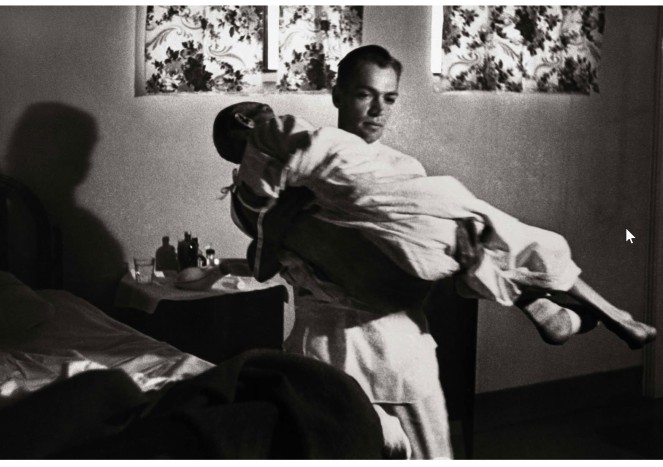
W Eugene Smith set out to document the life of the American GP Dr Ceriani for LIFE Magazine, entitled the “Country Doctor”. The process took 23 days to complete. W Eugene Smith spent some time initially with no film in his camera in order to get Dr Ceriani and his patients used to the camera’s presence.  The photographs document the day to day life of a GP, and whilst they are intended to be objective, there is also some empathy between the doctor and photographer.  For example the photograph of Dr Ceriani carrying an old man from the ward to the operating theatre shows that he is a caring doctor who will do as much as he can for his patients.


2020-02-12_16-16-03
Dr Ceriani carrying a patient from the ward to the operating theatre. © W Eugene Smith, Time Life Images/Getty Images


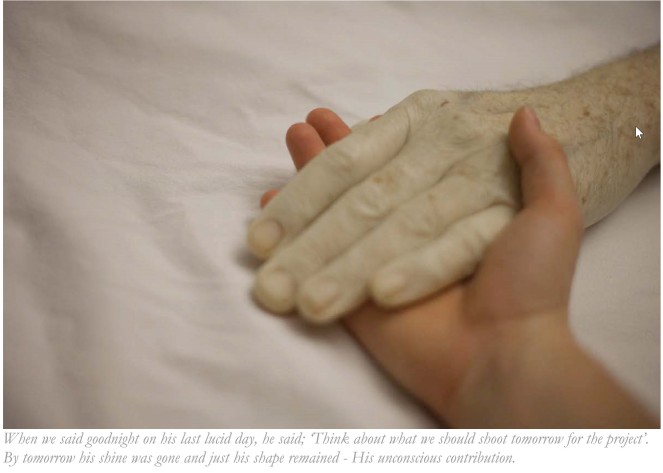
Bryony Campbell, in her Dad Project, set out to document the illness and subsequent death of her father.  In the process of doing this, she explored the relationship with her father, and of her relationship with her mother during this period.  The project was very personal, and on occasions she questioned whether she should be recording specific scenes.

2020-02-12_16-32-02
© Bryony Campbell

Her initial intention was for the project to be personal, not intended for others to see it, but after a while, she created  photo book, and exhibited the images.  The project was also published in various magazines and newspapers.  This, it turned out, was part of the healing process for Campbell.

Two photographic stories, but each with different purposes, and outcomes. W Eugene Smith’s story took just 23 days to complete, an objective story of a rural GP in America, but Bryony, on the other hand, because of the nature of the subject matter, would have had no idea how long she would be working on the project.  I was moved by the text linked to Campbell’s images, her thoughts and anxieties laid bare.

Campbell’s words: this is a story of an ending without an ending, seem to me to that although her father’s life has ended, he will never be forgotten because she made this photo story.  He will continue to live on in peoples minds as long as the photographs exist.