Part 5 · Research

Gregory Crewdson

The research point in the course text referred me to a Youtube clip which is no longer on available, so in answering the questions in the Research Point, I researched his work in other directions.

In an interview with John Southern on Youtube Crewdson said that he tries to create images which are familiar and mysterious at the same time. The images in his series “Twilight” are all of familiar scenes with ordinary people in their ordinary homes, but by using lighting in difference ways, attempts to create an aesthetic beauty in the images. His aim is to create tension between the ordinary and aesthetic beauty. I found this tension the most compelling aspect of the work. The subject in his series “Twilight” and “Cathedral of the Pines” are all ordinary, but there is something mysterious about their expressions. They all seem to be waiting for something to happen.

In the interview Crewdson also said he attempts to “drain” the meaning out of his subjects. There is no expression, and the story is open ended. This creates a psychological dimension to the work.

My main goal when creating images is to tell a story. That story does not necessarily have to have aesthetic beauty. If the images has beauty, that is an additional layer, but not always essential.

https://www.youtube.com/watch?v=3jLtNwPB9eY [accesses 09/11/20]

Crewdson’s work is planned in great detail, and he is assisted by many technicians. He says he does not actually hold a camera, but directs the photographer to create an image for him. Although Wall and DiCorcia also stage their images, they are in control of the camera. I cannot see that the processes are the same, so cannot Wall and DiCorcia should not be compared to Crewdson.

Part 5 · Uncategorized

Scene from Goodfellas

From this short clip of the film, which I have not seen before, I thought the overall impression is that the man has money, uses it to his advantage, and is the person from whom everyone wants to gain approval, even though secretly, they may not necessarily like him.  He has power. These signs are:

  • Had an expensively dressed women on his arm, the first time she had been out with him and was bemused by his actions
  • He left his car with a driver, told his girlfriend parking wastes time
  • Ignored the queues and went in through a back door and through the kitchen
  • No one in the kitchen was bothered about him walking through there, as if it was a regular occurrence
  • Staff on the doors all knew him and he tipped well
  • A table at the front was immediately set up for him
  • The men on the next table shook his hand, although the woman seemed a bit put out at being squashed in behind this new table
  • A bottle of bubbly was given as a present from another customer
  • His companion asked what he did for a living and he said construction, but changed it to something in the union when she noticed his unblemished hands
  • Probably not the case as he had more money that a union man might have.
  • Likely to be dishonest? Conman?


Part 4 · Uncategorized

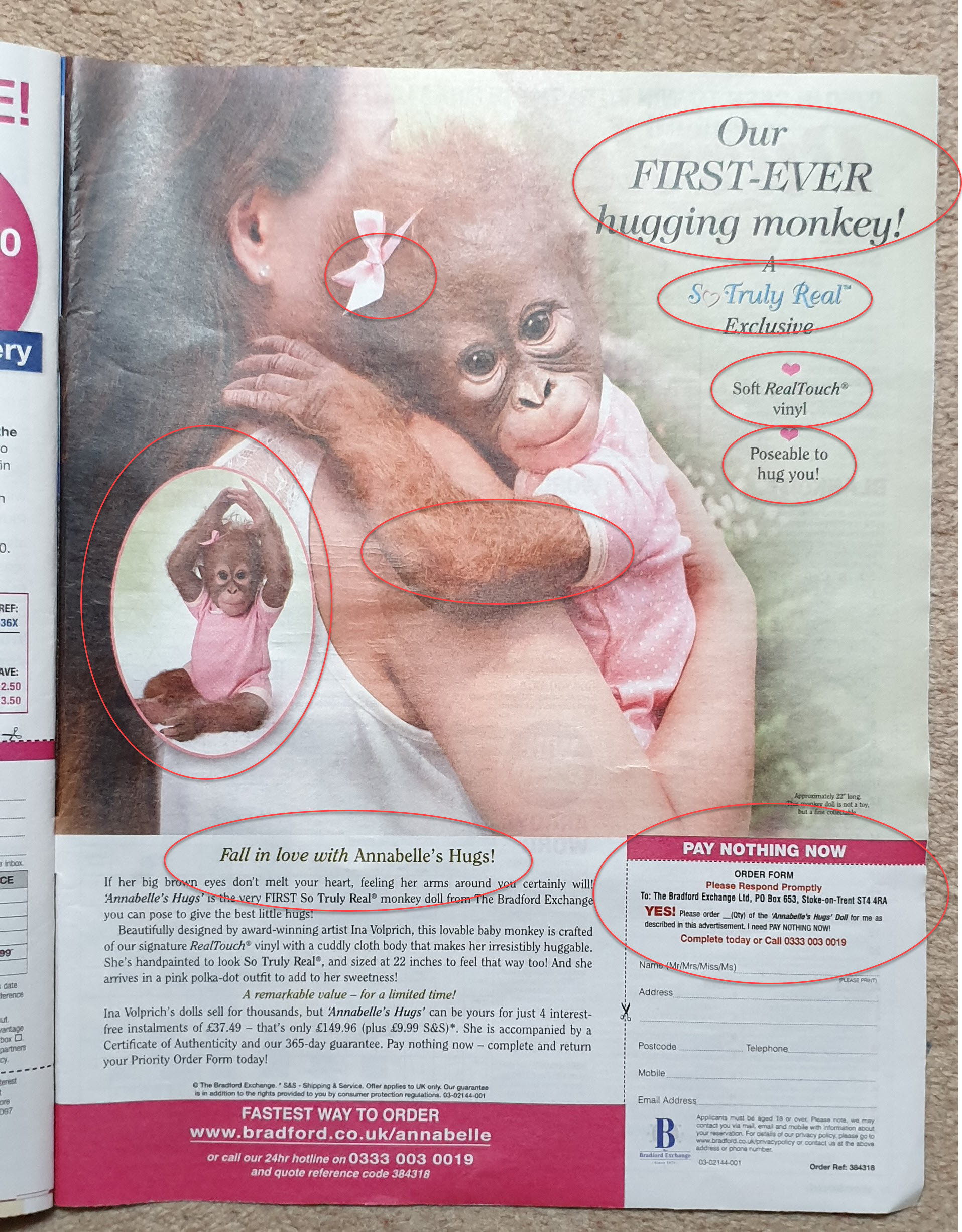
Advertisement for a Cuddly Toy

The French philosopher Jacques Derrida said that in order to understand an image, it should first be deconstructed. He also suggested that the viewer should not accept the image without question, but to explore and analyse the content. He encouraged the freedom to question.

I chose this advertisement because I found it confusing and wanted to try to understand what the advertisers were hoping to achieve.  I deconstructed the image as suggested by Derrida.

20200706_143402
Advertisement published in the Daily Mail Weekend Magazine 4 July 2020

These are my thoughts on the advertisement:

  • I found the image to be confusing, the line between animals and humans appears to have been erased.
  • The image shows a female, age unclear, cuddling a toy baby monkey dressed up to resemble a baby girl, complete with pink outfit and a pink bow in its hair.
  • As the image has been taken from a weekend colour supplement, not a child’s comic, and the wording of the advert is aimed at the reader, I assume this is a “grown-up’s” toy. Of course it could be purchased for a child, but given the actual cost, and the implication that it could be an investment, that would be unlikely.
  • Would this advert have had the same effect if the toy had been a human baby? By using a monkey to create the cuddly toy, is it then deemed acceptable to be owned by an adult?
  • Described as “Our First Ever hugging monkey” and “So Truly Real”. It cannot be real because it is representing what is essentially a wild animal posing as a human baby.
  • Made of “Soft RealTouch vinyl” and the arm of the monkey is shown with a light covering of hair. A real monkey does not have skin made from vinyl and yet this is portrayed as being soft and realistic.
  • “Poseable to hug you” implies that the monkey has put its arm around the adult in a warm and caring way, not that the arm has been arranged, thus giving the impression that this is a perfect substitute for a real baby.
  • A further image shows the monkey sitting independently, in a baby pose, again implying that the toy is a baby substitute.
  • The description implies love, comfort, warmth, security, suggesting that “If her big brown eyes don’t melt your heart, feeling her arms around you certainly will.”
  • Then at the end, having drawn the reader into this feel good advert, the advertisers use pressure to encourage a purchase:
    • Available for a limited time
    • Payment plan of 4 installments
    • Pay nothing now.

I am told that monkeys can make loving pets, but they are monkeys, not babies. To cross the line and create a toy monkey which looks and behaves like a human baby for purely commercial reasons is confusing. I wonder whether this advert is aimed at women who for various reasons do not have a baby to cuddle and the monkey is a “respectable” substitute.

Part 4 · Uncategorized

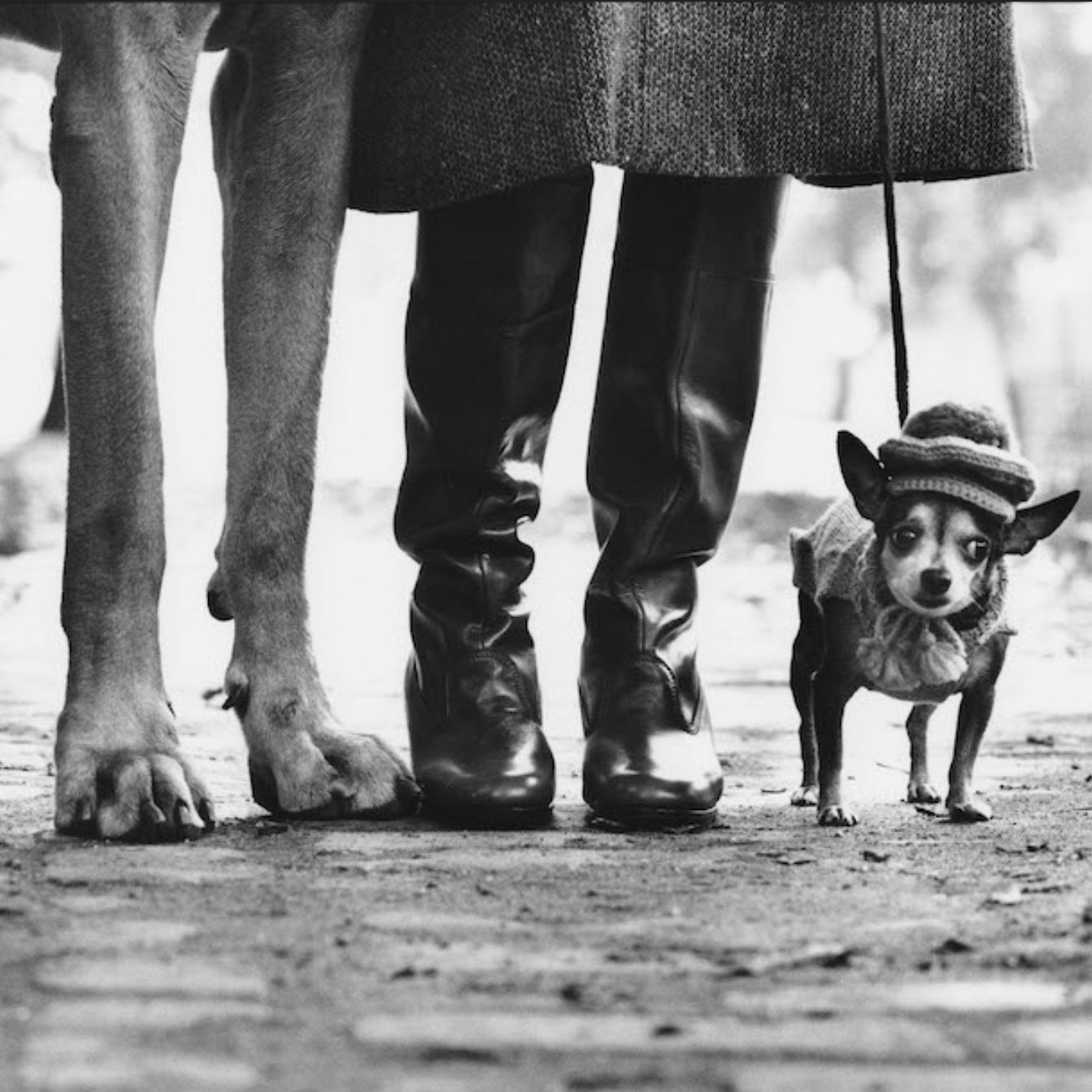
Exercise: Elliot Erwitt – Dogs

Erwitt
Elliot Erwitt, New York 1974

Erwitt, a Magnum photographer,  was known for his photographs of dogs and when I researched his work I noticed that most of his “dog” photographs were taken at the eye level of the dog and not necessarily at the eye level of any people in the photographs.

In this photograph I think he set out to make the small dog the main subject, with the feet of the person and other much larger dog secondary.  He may have included the whole of the person and larger dog originally, but by cropping them out in this way, it makes for an amusing image.

Looking at the coat and boots I assume the person is female, affluent and a dog lover and it appears she is walking her dogs in a park.  Erwitt was influenced by Henri Cartier-Bresson and the “Decisive Moment”, but this photograph does appear staged.  The woman and both dogs are stationary at the moment the photograph was taken.  Perhaps he approached her and asked if he could take a photograph, and she was happy to oblige, stopping for a few seconds in front of the camera as he knelt down to the level of the smaller dog.

Erwitt focussed on the feet of the subjects as the background behind the subjects is out of focus and over exposed, which I think would have been intentional to ensure the viewer looked at the subjects rather than the background.

Part 3 · Uncategorized

Childhood Memories

This was a difficult exercise because I had a very varied childhood, partly because I had chronic asthma, so was rarely at school, but also because my father’s job took him to different places.  We moved around a lot,  I moved schools, made different friends and felt I didn’t really belong anywhere.  But there was one constant throughout my childhood.  Our horses. My two sisters and I were bought our first pony when I was 7 years old.  Of course, one pony was not enough for three active girls and we soon had one each.  I competed in all the local shows, and was an active member of the Pony Club. I remember that during those years, despite my asthma, I was always felt fit and well when around the ponies.

I don’t have any photographs of myself during that time as they are all packed away in a box my sister’s loft 100 miles away.  And it is not something which could be recreated easily without access to horses – which I don’t have.

When I became a parent, it turned out my daughter had the same interest in horses as me and I was able to relive my childhood through her.  I bought her a pony, went to all the shows, attended Pony Club events, and generally enjoyed recreating the life I had had all those years ago.

I decided to recreate my childhood memories by using a photograph of my daughter aged 10 years competing at a local cross country event, with me taking a photograph of her as my mother would have done when I was 10 years old.  I used Photoshop to create the photograph, adding myself to the image, and although I have achieved what I set out to do, it is not perfect.  However, it is a representation of my childhood – my daughter as me, and myself as my mother.

Rebecca at Cross Country
Rebecca competing at the Blackhorse Cross Country Event aged 10 years.


This exercise brought back memories of my childhood, the excitement, the nerves, the disappointment or elation depending on the outcome of a competition. It also brought back memories of the time spent with my daughter and her pony.  She is now 36, and those years have passed, but we both have strong memories of those times.

I think anyone viewing this photograph would understand the subject matter, but would need to read the narrative to understand how it is a representation of my childhood.


Part 3 · Research · Uncategorized

Duane Michals

Duane Michals is an American photographer who annotates much of his work and by combining text with images enhances their meaning.  In the example referred to in the course text: This Photograph is My Proof  (1974).

This Photo is my proof

The text indicates that the photograph was taken some time before the text was added.  But the question is raised as to whether she still loves him now, if not why did the relationship change?  Was it something which he did to affect the situation, or did she break it off.  Something far more tragic could have happened, perhaps she passed away and he just needed reassurance that they were happy when she was still alive.

The handwritten notes give the whole image a more intimate feel, but is not necessarily proof that the author of the note was also the subject of the photograph.  The photographer could have added this caption to create an ambiguity to it.

In his series Chance Meeting the same ambiguity has been embedded into the story. Do they actually know each other, or does the man with glasses think he knows the other man, but may not.

Chance Meeting

By adding narrative in this way, rather than explaining the meaning of a photograph, Michal gives the viewer the ability to make their own minds up.


Part 3 · Uncategorized

Exercise: Nigel Shafran

Nigel Shafran started his career as a fashion but now focusses on photographing the mundane, and often unnoticed people and parts of society.  I was fascinated by his series Bookshelves, as I felt that each image reflected the character of the owner of that bookshelf.  I would love to have talked to the owners of those bookshelves to see how my interpretation of the images was in line with the owners’ personality.

In his series Washing Up, Shafran created a series of images of the kitchen sink and draining board after the washing up had been done, but with different items on the draining board and different captions describing each scenario.

I addressed the questions in the exercise as follows:

Did it surprise you that this was taken by a man? Why?

No, I was not surprised.  In our culture it is acceptable for both men and women to do the washing up, and he was recording an activity that he would probably have participated in.   Given his style of photography, photographing the mundane, it seems to fit with this series.

In your opinion does gender contribute to the creation of an image?

I do think gender can effect the creation of an image, but I believe it depends on the subject and scenario rather than the abilities of the photographer.  In some situations a female photographer is more likely to be accepted or even unnoticed.  For example,  Doreen Spooner, the first female Fleet Street photographer, was able to take a photograph of Christine Keeler and Mandy Rice-Davies taking a break from the Old Bailey trial of Stephen Ward in July 1963.  They were sitting near the ladies toilets, and she was able to hide in the ladies and take the photograph unnoticed.  A male photographer would not have had such an opportunity.

Christine Keeler and Mandy Rice-Davies were prime press targets during the Old Bailey trial of society osteopath Stephen Ward in July 1963

Spooner was able to snap Keeler and Rice-Davies at a pub in Holborn by hiding in the ladies’ loo. ‘I put the door ajar and stuck the camera through it,’ she recalled. ‘My heart was in my mouth as it was very dingy in there… I developed them and what a relief when I saw they’d come out.’ The shot was splashed on the front page.

https://www.msn.com/en-gb/news/photos/the-pictures-of-doreen-spooner-a-life-through-the-lens/ss-BBWjT8J#image=2 [accessed 21/5/2020]

Keeler and RiceDavies
Christine Keeler and Mandy Rice-Davies photographed by Doreen Spooner. © Mirrorpix

What does this series achieve by not including people?

In his series Washing up, Shafran achieves anonymity by not including people.  Most people at some time in their lives will have to do washing up in some form or other, regardless of their culture, ethnicity or gender.  By not including people, he has reinforced this as a multicultural, multi ethnic and non gender specific activity.

Do you regard them as interesting “still life” compositions?

I think that had Shafran omitted the captions, they would be less interesting, but by adding the captions he has brought the compositions to life. It makes them intimate and personal. Unfortunately I was unable to find the whole set of images where the captions were included, but the example shown in the course text does show how the captions describe the scenarios.

Part 3 · Uncategorized

Autobiographical self-portraiture

I looked at the work of three photographers who use autobiographical self-portraiture in their work: Francesca Woodman, Elina Brotherus and Gillian Wearing.

Francesca Woodman

Francesca Woodman was a troubled person – she sadly committed suicide at the age of just 22 years. She was a prolific photographer and her family now have some 800 images which she took during her short life. It is a tragedy that anyone should be so troubled that they would take their own life and I felt very sad looking at the images in the series Space2. And ironically, her work only became well known and accepted after her death.

I knew she had taken her life before I looked at her series Space2, and I’m not sure I would have grasped that she was so troubled just by looking at the images. I think the narrative is part of these images, and helps me to understand why she created them.

Anyone suffering from depression so severely is, by the very nature of the illness, totally self centred, therefore in the case of Woodman, I do not consider these images are created as a result of self indulgence or narcissistic tendencies. It is likely that her thoughts were confined to the boundaries of her depression, and in the series Space2 she was expressing those thoughts. The images in which she is almost not there, a ghost image, or a blur, indicate to me that she felt an outsider, a misfit, not part of conventional society. Hiding behind wall paper, posing naked, tells me that she was expressing her feelings of vulnerability.

I don’t believe think she was addressing wider issues because her depression would probably have prevented her from thinking about anything outside her immediate world.

Elina Brotherus

In her series Annonciation, Elina Brotherus used photography to express her sadness of her failed attempts at IVF, and I think that unlike Woodman her aim was to tell others of her experiences and sadness. In an interview quoted in the course text she says she prefers to tell her story through photographs as she is still too sad to give interviews. I looked through her series as she progresses through each attempt at IVF, and felt she had stripped her inner feelings from her body as she worked through the photographic story. I felt that the images in which she is naked show her as losing everything, even the protection of her clothes.

This is not a journey in the world of narcissim or self-indulgence, but the telling of a story. She says that so often we see the success stories surrounding IVF but not the sadness surrounding failed attempts. 3 particular images caught my attention:

Annonciation 14: she is sitting in a bathroom with a figure in the background. She has her back to this person, and is alone in her grief. Who is that person, her partner, a doctor?  We will never know.

Annonciation 21, New York. This is the only image, apart from Annonciation 14, which includes a male figure, presumably her partner. In all other images she is alone, showing just how failed IVF can become all consuming to the point that a loving relationship becomes secondary to the task in hand.

Annonciation 27: this is the only image where she is smiling, as though she has a secret but can’t tell anyone yet. Did she think this time the treatment has worked? But we know it didn’t because the series progresses with further failures.

A desperately sad set of images but with an important message: IVF is not always successful and these stories are often left untold.

Brotherus went on to create a series Carpe-Fucking-Diem in which she starts moving on and realizing that she will remain childless, but that the world goes on as normal, regardless. She photographed herself in ordinary situations, and in some cases, with humour that was not seen in Annonciation. Some of these images were taken during her IVF treatment but mostly after she had come to terms with failed IVF.

A man, presumably her partner, appears in several photographs, which indicated to me that their relationship had changed, he was no longer excluded from her world of grief. I felt that she was using the process of creating this series as therapy and closure.

Gillian Wearing

Wearing followed a number of photographers in focusing on family as well as self-portrait, combining the two. She set out to create a series of images by creating masks resembling members of her family, with the eyes cut out, and then photographed herself wearing them. She was inspired by the work of Claude Cahun, and her work was displayed alongside Cahun’s work at the National Portrait Gallery in 2017. Cahun like Wearing created images using masks, using them in self-portraiture.

This departure from the usual “selfie” indicates to me that Wearing was not doing this for narcissistic reasons but to show that roles in families are interchangeable, everyone can put on the persona of another member of the family. I felt that the process of making the masks was as important to Wearing as taking the photographs of the end product.

Mask Gillian Wearing

https://www.theguardian.com/artanddesign/gallery/2012/mar/27/gillian-wearing-takeover-mask


The three photographers shown here, although all working in self-portraiture, have different ways of working and different reasons for producing this type of image.

Part 2 · Uncategorized

Personal Stories

Peter Mansell, Dewald Botha and Jodie Taylor: the three examples of their personal stories are very different, but all have one thing in common: without a narrative they would appear very mundane to the viewer.

I was unable to view all the images created by Jodie Taylor, except the image of the garage block, but was able to get a feel for the type of images she had created as she returned to her childhood locations.

I didn’t feel that the set of images created by Dewald Botha in the Ring Road portrayed exactly how he felt.  He said that he started out the project “as an exploration of a physical object”, but over time the project became more personal, and developed into a “metaphor for distance placed and personal limits reached”.  Simply viewing his images would not have given me an understanding of this development had I not read his narrative accompanying the images.

The project which resonated with me most was that of Peter Mansell.  I am not a paraplegic, and thankfully I am now fit and active.  However, this was not always the case, as I grew up a chronic asthmatic in the days before the new generation on inhalers.  I now lead an active life due to the medication, not because I have “grown out” of asthma.  When I was young I was crippled by the desease, at a time when not much was known about it.  When I managed to get to school, which was rare, I was bullied because the other children thought I had an infectious desease.  As I write this I realise how much of my childhood I have chosen to forget, and this is bringing it back.  Peter Mansell said he could write about his experiences, or create pictures, but “in doing so, the reader or viewer would have to rely wholly on my imagination and abilities of expression”. He felt that using photography as the medium there is “a direct relationship with reality at its centre”.

In the past I have tried writing about my childhood experiences without success, but perhaps I will think about Peter Mansell’s approach to exploring his disability and consider photography as the most appropriate medium.


When viewing an image, the viewer will always project their own experiences and emotions onto the image.  I initially feel defensive when I lose control of one of my images in this way, followed by a period of anger.  Why can’t people see an image as I do?  Then the anger passes and my confidence in my ability drains away.  I have a tendency to hide my images away on my laptop, instead of displaying them on social media or publicise the URL to my blog.  This has made me realise I should be more open and display my images for others to see.  What others make of them is a matter for those viewers not me.

Part 2 · Uncategorized

A Poem in Pictures

For this exercise I selected the lyrics to the Simon and Garfunkel song The Sound of Silence.  I have always been a fan of Simon and Garfunkel’s music, especially the lyrics, and more recently was amazed at the cover version recorded by Disturbed, a heavy metal rock band. The lead singer, David Draiman, shows a different side to his voice and personality, producing a beautiful sound.  I my view it is better than the original Simon and Garfunkel version. I created a story board and planned to visit London to create a set of images. Then came the news that all unnecessary travel should be avoided, closely followed by a full lockdown due to Covid-19.  So my plans were scuppered!  I decided, rather than try to change my plans, I would upload my story board instead.  I felt that this would be preferable to trying to find another poem and recreate a new story board. Fortunately I was able to use a few images from a previous trip to London when I took a series of night time photographs around Southwark, and I have embedded these into the storyboard where appropriate.

The Sound of Silence

Simon and Garfunkel

Hello, darkness, my old friend
I’ve come to talk with you again
Because a vision softly creeping
Left its seeds while I was sleeping
And the vision that was planted in my brain
Still remains
Within the sound of silence

In restless dreams I walked alone
Narrow streets of cobblestone
‘Neath the halo of a streetlamp
I turned my collar to the cold and damp
When my eyes were stabbed by the flash of a neon light
That split the night
And touched the sound of silence

And in the naked light I saw
Ten thousand people, maybe more
People talking without speaking
People hearing without listening
People writing songs that voices never share
No one dared
Disturb the sound of silence

“Fools,” said I, “You do not know
Silence like a cancer grows
Hear my words that I might teach you
Take my arms that I might reach you.”
But my words like silent raindrops fell
And echoed
In the wells of silence

And the people bowed and prayed
To the neon god they made
And the sign flashed out its warning
In the words that it was forming
And the sign said, “The words of the prophets
Are written on the subway walls
And tenement halls
And whispered in the sounds of silence.”

Lyrics written by Paul Simon

Paul Simon said these words were written to show how he felt about society and his view that we no longer communicate effectively.  However, I feel these words are just as relevant today and can be applied to the plight of the homeless, the invisible members of our modern society who are consigned to sleeping in the cold and dark streets in many cities across the world.  I wanted to include images of people during rush hour on escalators in the London Underground.  The words in verse three sum up my impressions of a busy Underground station.

People talking without speaking, people hearing without listening

This story board consists of some sketches of the final images, and some actual photographs I was able to take before the lockdown.    I hope to be able to visit London to create the additional images of homeless people, and of a typical scene on the underground at rush hour before submitting for assessment, but that depends on the extent of the Covid-19 virus lock down.