Part 3 · Uncategorized

Childhood Memories

This was a difficult exercise because I had a very varied childhood, partly because I had chronic asthma, so was rarely at school, but also because my father’s job took him to different places.  We moved around a lot,  I moved schools, made different friends and felt I didn’t really belong anywhere.  But there was one constant throughout my childhood.  Our horses. My two sisters and I were bought our first pony when I was 7 years old.  Of course, one pony was not enough for three active girls and we soon had one each.  I competed in all the local shows, and was an active member of the Pony Club. I remember that during those years, despite my asthma, I was always felt fit and well when around the ponies.

I don’t have any photographs of myself during that time as they are all packed away in a box my sister’s loft 100 miles away.  And it is not something which could be recreated easily without access to horses – which I don’t have.

When I became a parent, it turned out my daughter had the same interest in horses as me and I was able to relive my childhood through her.  I bought her a pony, went to all the shows, attended Pony Club events, and generally enjoyed recreating the life I had had all those years ago.

I decided to recreate my childhood memories by using a photograph of my daughter aged 10 years competing at a local cross country event, with me taking a photograph of her as my mother would have done when I was 10 years old.  I used Photoshop to create the photograph, adding myself to the image, and although I have achieved what I set out to do, it is not perfect.  However, it is a representation of my childhood – my daughter as me, and myself as my mother.

Rebecca at Cross Country
Rebecca competing at the Blackhorse Cross Country Event aged 10 years.


This exercise brought back memories of my childhood, the excitement, the nerves, the disappointment or elation depending on the outcome of a competition. It also brought back memories of the time spent with my daughter and her pony.  She is now 36, and those years have passed, but we both have strong memories of those times.

I think anyone viewing this photograph would understand the subject matter, but would need to read the narrative to understand how it is a representation of my childhood.


Part 3 · Research · Uncategorized

Duane Michals

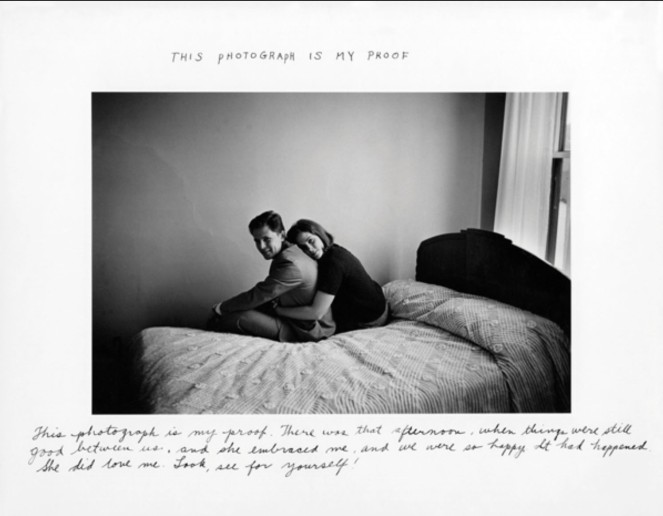
Duane Michals is an American photographer who annotates much of his work and by combining text with images enhances their meaning.  In the example referred to in the course text: This Photograph is My Proof  (1974).

This Photo is my proof

The text indicates that the photograph was taken some time before the text was added.  But the question is raised as to whether she still loves him now, if not why did the relationship change?  Was it something which he did to affect the situation, or did she break it off.  Something far more tragic could have happened, perhaps she passed away and he just needed reassurance that they were happy when she was still alive.

The handwritten notes give the whole image a more intimate feel, but is not necessarily proof that the author of the note was also the subject of the photograph.  The photographer could have added this caption to create an ambiguity to it.

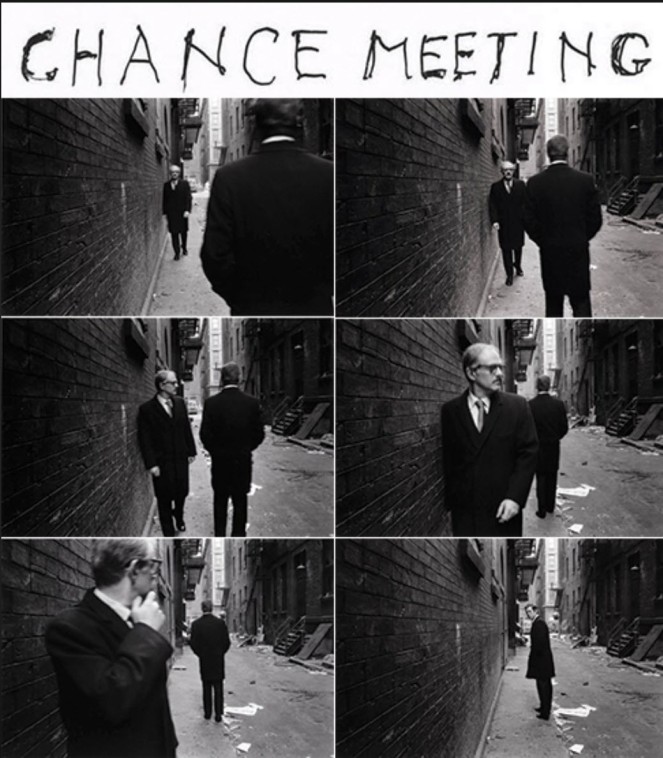
In his series Chance Meeting the same ambiguity has been embedded into the story. Do they actually know each other, or does the man with glasses think he knows the other man, but may not.

Chance Meeting

By adding narrative in this way, rather than explaining the meaning of a photograph, Michal gives the viewer the ability to make their own minds up.


Part 3 · Uncategorized

Exercise: Nigel Shafran

Nigel Shafran started his career as a fashion but now focusses on photographing the mundane, and often unnoticed people and parts of society.  I was fascinated by his series Bookshelves, as I felt that each image reflected the character of the owner of that bookshelf.  I would love to have talked to the owners of those bookshelves to see how my interpretation of the images was in line with the owners’ personality.

In his series Washing Up, Shafran created a series of images of the kitchen sink and draining board after the washing up had been done, but with different items on the draining board and different captions describing each scenario.

I addressed the questions in the exercise as follows:

Did it surprise you that this was taken by a man? Why?

No, I was not surprised.  In our culture it is acceptable for both men and women to do the washing up, and he was recording an activity that he would probably have participated in.   Given his style of photography, photographing the mundane, it seems to fit with this series.

In your opinion does gender contribute to the creation of an image?

I do think gender can effect the creation of an image, but I believe it depends on the subject and scenario rather than the abilities of the photographer.  In some situations a female photographer is more likely to be accepted or even unnoticed.  For example,  Doreen Spooner, the first female Fleet Street photographer, was able to take a photograph of Christine Keeler and Mandy Rice-Davies taking a break from the Old Bailey trial of Stephen Ward in July 1963.  They were sitting near the ladies toilets, and she was able to hide in the ladies and take the photograph unnoticed.  A male photographer would not have had such an opportunity.

Christine Keeler and Mandy Rice-Davies were prime press targets during the Old Bailey trial of society osteopath Stephen Ward in July 1963

Spooner was able to snap Keeler and Rice-Davies at a pub in Holborn by hiding in the ladies’ loo. ‘I put the door ajar and stuck the camera through it,’ she recalled. ‘My heart was in my mouth as it was very dingy in there… I developed them and what a relief when I saw they’d come out.’ The shot was splashed on the front page.

https://www.msn.com/en-gb/news/photos/the-pictures-of-doreen-spooner-a-life-through-the-lens/ss-BBWjT8J#image=2 [accessed 21/5/2020]

Keeler and RiceDavies
Christine Keeler and Mandy Rice-Davies photographed by Doreen Spooner. © Mirrorpix

What does this series achieve by not including people?

In his series Washing up, Shafran achieves anonymity by not including people.  Most people at some time in their lives will have to do washing up in some form or other, regardless of their culture, ethnicity or gender.  By not including people, he has reinforced this as a multicultural, multi ethnic and non gender specific activity.

Do you regard them as interesting “still life” compositions?

I think that had Shafran omitted the captions, they would be less interesting, but by adding the captions he has brought the compositions to life. It makes them intimate and personal. Unfortunately I was unable to find the whole set of images where the captions were included, but the example shown in the course text does show how the captions describe the scenarios.

Part 3 · Uncategorized

Autobiographical self-portraiture

I looked at the work of three photographers who use autobiographical self-portraiture in their work: Francesca Woodman, Elina Brotherus and Gillian Wearing.

Francesca Woodman

Francesca Woodman was a troubled person – she sadly committed suicide at the age of just 22 years. She was a prolific photographer and her family now have some 800 images which she took during her short life. It is a tragedy that anyone should be so troubled that they would take their own life and I felt very sad looking at the images in the series Space2. And ironically, her work only became well known and accepted after her death.

I knew she had taken her life before I looked at her series Space2, and I’m not sure I would have grasped that she was so troubled just by looking at the images. I think the narrative is part of these images, and helps me to understand why she created them.

Anyone suffering from depression so severely is, by the very nature of the illness, totally self centred, therefore in the case of Woodman, I do not consider these images are created as a result of self indulgence or narcissistic tendencies. It is likely that her thoughts were confined to the boundaries of her depression, and in the series Space2 she was expressing those thoughts. The images in which she is almost not there, a ghost image, or a blur, indicate to me that she felt an outsider, a misfit, not part of conventional society. Hiding behind wall paper, posing naked, tells me that she was expressing her feelings of vulnerability.

I don’t believe think she was addressing wider issues because her depression would probably have prevented her from thinking about anything outside her immediate world.

Elina Brotherus

In her series Annonciation, Elina Brotherus used photography to express her sadness of her failed attempts at IVF, and I think that unlike Woodman her aim was to tell others of her experiences and sadness. In an interview quoted in the course text she says she prefers to tell her story through photographs as she is still too sad to give interviews. I looked through her series as she progresses through each attempt at IVF, and felt she had stripped her inner feelings from her body as she worked through the photographic story. I felt that the images in which she is naked show her as losing everything, even the protection of her clothes.

This is not a journey in the world of narcissim or self-indulgence, but the telling of a story. She says that so often we see the success stories surrounding IVF but not the sadness surrounding failed attempts. 3 particular images caught my attention:

Annonciation 14: she is sitting in a bathroom with a figure in the background. She has her back to this person, and is alone in her grief. Who is that person, her partner, a doctor?  We will never know.

Annonciation 21, New York. This is the only image, apart from Annonciation 14, which includes a male figure, presumably her partner. In all other images she is alone, showing just how failed IVF can become all consuming to the point that a loving relationship becomes secondary to the task in hand.

Annonciation 27: this is the only image where she is smiling, as though she has a secret but can’t tell anyone yet. Did she think this time the treatment has worked? But we know it didn’t because the series progresses with further failures.

A desperately sad set of images but with an important message: IVF is not always successful and these stories are often left untold.

Brotherus went on to create a series Carpe-Fucking-Diem in which she starts moving on and realizing that she will remain childless, but that the world goes on as normal, regardless. She photographed herself in ordinary situations, and in some cases, with humour that was not seen in Annonciation. Some of these images were taken during her IVF treatment but mostly after she had come to terms with failed IVF.

A man, presumably her partner, appears in several photographs, which indicated to me that their relationship had changed, he was no longer excluded from her world of grief. I felt that she was using the process of creating this series as therapy and closure.

Gillian Wearing

Wearing followed a number of photographers in focusing on family as well as self-portrait, combining the two. She set out to create a series of images by creating masks resembling members of her family, with the eyes cut out, and then photographed herself wearing them. She was inspired by the work of Claude Cahun, and her work was displayed alongside Cahun’s work at the National Portrait Gallery in 2017. Cahun like Wearing created images using masks, using them in self-portraiture.

This departure from the usual “selfie” indicates to me that Wearing was not doing this for narcissistic reasons but to show that roles in families are interchangeable, everyone can put on the persona of another member of the family. I felt that the process of making the masks was as important to Wearing as taking the photographs of the end product.

Mask Gillian Wearing

https://www.theguardian.com/artanddesign/gallery/2012/mar/27/gillian-wearing-takeover-mask


The three photographers shown here, although all working in self-portraiture, have different ways of working and different reasons for producing this type of image.