Galleries and Exhibitions

William Blake at Tate Britain

This exhibition contained 100s of examples of Blakes work including both his artwork and poetry.  A great deal of work had gone into curating it and pulling all these works together.

When I first entered the exhibition I was struck the by the quantity of examples of he work just in the first room.  He started his career as an apprentice engraver, and he did this work during the day in order to fund his own creative work.  He was helped by his wife Catherine who was married to him for 45 years, until his death.

Initially I was intrigued by his work.  I was fascinated by the intricacy of the prints made using his own technique of making prints using a “relief etching” process enabling him to introduce colours into his prints.  At the same time he was developing his career as a poet and many of his prints consisted of intricate scripts decorated with complex designs.

Tyger tyger
Tyger Tyger Burning Bright. William Blake

As Blake progressed through life his religious beliefs became stronger.  His work had a strong religious influence, and he created a number images of his own “made up” mythology.  This made me start to doubt his mindset at this time in his life, he was clearly a troubled man.

As I progressed around the exhibition I found his work became darker and that, combined with the subdued lighting in the exhibition, started to make me feel uncomfortable.  I did try to focus on the lighter works, such as his etchings of the Canterbury tales, but in the end left the exhibition well before the end of the 2 hours agreed for the viewing.

canterbury tales

We had a discussion following the viewing, and everyone took something different away from it.  I was interested to hear the other student’s views, but I still had an uncomfortable feeling about Blake’s work.  However, I am pleased I went to the exhibition because I believe that we must all experience different works before we can put forward our own opinions of artists and photographers.


Galleries and Exhibitions

Magnum Manifesto Exhibition

On 3rd December I visited the Magnum Manifesto Exhibition at Compton Verney Art Gallery.  This was a very well curated exhibition displaying images created by some 40+ members of the agency.  Firstly I investigated the background to the agency and why it was established.  According to the Compton Verney website:


In 1947, following the aftermath of the Second World War, four pioneering photographers founded a now legendary alliance, combining an extraordinary range of individual styles into one powerful collaboration: The Magnum Photos agency.

https://www.comptonverney.org.uk/thing-to-do/magnum-manifesto-2/ [accessed 4/12/19]

The four pioneering photographers were:

  • Robert Capa
  • Henri Cartier-Bresson
  • George Rodger
  • David “Chim” Seymour

The ethos of the group was to embrace the articles of the Universal Declaration of Human Rights, and this exhibition developed this ethos and displayed photographs old and new taken by members of the Magnum Photos Agency.

20191203_140034

The exhibition was divided into 3 parts.

Part 1: Human Rights and Wrongs

20191203_131410 (2)

A display of images showed some harrowing scenes of post war refugees.  On poignant image was that of an old lady saying goodbye to a loved one in Turkey taken by Ara Guler.  Was the passenger setting off with the hope of the better life?

Saying Goodbye on the Galata Quay
Saying Goodbye on the Galata Quay. C Ara Güler 1955


Part 2: An Inventory of Differences


20191203_125949 (2)

These images showed the abnormal and marginalised.  Many were taken in asylums and mad houses.  There seemed to be a renewed interest in these types of people and places because the post war period had little to shock.  Life had become prosperous, so those differences became the focus of the photographer.

SS tatoo
Young neo-nazi showing his SS tatoo. c Leonard Freed 1989


Part 3: Stories about Endings


20191203_133121 (2)

The Broken Manual

One of the sets of images had been taken by Alex Soth.  He took a series of photographs of people in America who had dropped out of society, lived alone, lived a self sufficient life and he created a manual on how to disappear. However, because of his concerns for its intrusiveness and that these people had become hidden from society, he decided to create a hidden book.  The actual book was hidden inside another book which had been hollowed out.

Broken Manual
The Broken Manual, Somewhere to Disappear.  c Alec Soth 2010


Overall I feel privileged to see this collection of images created by members of Magnum Photos agency, as it is rare for all of these images to come together into one exhibition.


Reflections · Uncategorized

Eye Witnesses, reliable or not!

Link to exercise 1.1: Eye-witness

When I first looked at the photographs of the coloured man abusing a Jewish father and child I thought they were objective. But when I analysed the photos, and watched the video from which these photos were taken, I changed my mind.  Those four photographs do not tell the whole story, particularly when I heard the conversation.  I learnt that you cannot assume photographs are objective and accurate as this may no be the case.

I also learnt, from working on the images of HRH Andrew, Duke of York, that in some cases where the eye-witnesses are only the photographer and those in the image, it is very difficult to establish the reliability of the content of the image where the eye-witnesses differ in their recollection of the events at the time.


Galleries and Exhibitions

The Art of Innovation – Science Museum

Together, art and science help us to interpret, study and explore the world around us.

Examining this ongoing relationship, The Art of Innovation: From Enlightenment to Dark Matter looks at the interaction between scientific progress and social change, how machinery has both influenced and threatened the human body and how tools that go beyond human senses can capture the unseen.

https://www.sciencemuseum.org.uk/see-and-do/art-innovation-enlightenment-dark-matter [accessed 1/12/19]

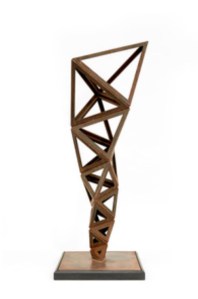
As you enter the exhibition you see a sculpture by Conrad Shawcross called Paradigm, a scaled down version of his original model commissioned by the Sir Francis Crick Institute.

Commissioned by the Francis Crick Institute and funded by the Wellcome Trust, Paradigm, by artist Conrad Shawcross, is one of the tallest public sculptures in central London.  At an imposing 14 metres, it comprises of a twisting stack of tetrahedra that grow in size. The work is a feat of engineering and continues the artist’s long-standing collaboration with structural engineering practice Structure Workshop.

Thomas Kuhn’s theory of the ‘paradigm shift’ provided a starting point for Shawcross’ work for the Crick. Kuhn, an American philosopher of science, believed that scientific advancement does not progress in a seamless linear fashion, but rather through massive shifts that lead to breakthroughs, which change the course of thought, comprehension and application.

https://www.crick.ac.uk/about-us/our-history/our-building/paradigm [accessed 27/11/19]


Paradigm
Paradigm by Conrad Shawcross

The exhibition was divided up into four sections: Sociable Science, Human Machines, Troubled Horizons, Meaningful Matter.

Sociable Science

This section covered the earlier scientific discoveries which affected both the scientific community, and society.  A painting depicting a lecture being delivered to a mixed group using an Orrery by Joseph Wright of Derby was prominently displayed.

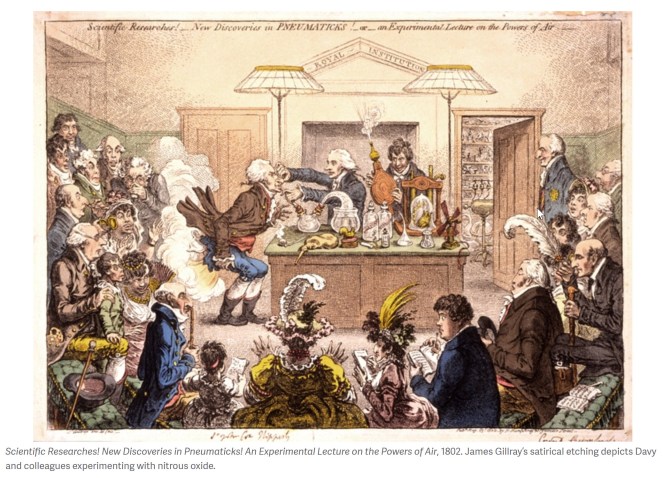
In this area we learnt about David Humphrey and his experiments with Nitrous Oxide, complete with the sceptics.  Many people thought this was all “hot air”, hence the proliferation of cartoons relating to it.  A cartoon by James Gillray depicting a lecture being delivered by Humphrey on the merits of Nitrous Oxide was on display.

2019-11-29_11-25-00

At that time dyes were being developed, particularly in use by architect and textile designer Charles Francis Annesly Voysey. At the time mauve became very popular, but unfortunately tended to fade.  It became so popular, that “ladies of ill reput” were frequently seen wearing this colour.  Hence the quotation from Dorian Grey (Oscar Wild): “Never trust a woman in purple”.

Human Machines

This section covered machines which have had an impact on the artistic world.  Prosthetic limbs and artistic images of those with the limbs, Eadweard Muygridge’s work with movement, particularly the horse.


Muybridge’s  Zoopraxiescope used to create pictures of moving animals when researching movement.

Muybridge

Muybridge’s moving horse

At the same time, in France Etienne-Joules Marey was working on capturing movement in images.

Marey


Troubled Horizons and Meaningful Matter

This section focussed on the changes and the effects on the environment as a result of man’s technology.  Although much of the work on display related to earlier in the 20th century, it is still current.

The exhibition was very well curated and yet again reinforced the fact that science and art can work together to explore and develop new artifacts and technologies.


Research

Judith Williamson

AdvertJudith Williamson’s article in Source magazine regarding an advertisement for an Apple ipad opened up a whole new way of looking at advertisements for me.  I initially saw the picture of a girl lying in bed looking at an ipad.  But when I read Judith’s article, I could see that the way the lighting was set, the fact that it was difficult to tell the girl’s ethnicity, thus indicating a multi national product, and the words “Designed by Apple in California” all have a bearing on the way this photograph is perceived.  When I read on, according to Williamson, the actual item would have been manufactured in a “sweat shop” in China so it is obvious why Apple has indicated its design was in California, with no mention of the manufacturing process or location.

So looking at this photograph, the narrative may be a young girl lying in bed looking at her ipad, with the light shining down onto her in an ethereal way.  But the context is very different, particularly when investating the production of the ipad, and the conditions of those actually producing it.

I will certainly be viewing advertisements in a different way in future, analysing the narrative and context to give the complete “picture”.  I will also read more of Judith Wliiamson’s articles.


Galleries and Exhibitions · Uncategorized

Douglas Meadows at the Weston Gallery, Bodleian Library, Oxford

The Bodleian Library, Oxford has acquired the archives of photographer Douglas Meadows.  The archives were on display at the Weston Gallery for a short time and I went to see the exhibition on 21st November.

20191121_135418

In 1974 Douglas Meadows bought a 1948 bus, converted it to a camper van including a darkroom, and armed with £2000 in grants, set off around the country to photograph anyone who volunteered. All photographs were developed overnight in his bus, and then a free copy was given to the subject the following day. He said “everyone is entitled to be ordinary” and as such all the subjects were ordinary working people – no celebrities or aristocrats.

In the late 1990s he set out to track down those people and take an up to date photograph. This wasn’t an easy process as he hadn’t taken names. That was the ethos he adopted when first taking the photos. So the only way was to select three venues, Southampton, Hartlepool and Easington, and ask the local papers to publish the original photographs. As a result many people came forward and new photographs were taken.

The exhibition displayed these photographs side by side, alongside the newspaper cuttings, and also some of the recordings he made during his journey in 1964 were available. Altogether an entrancing exhibition, and a great record of then and now.

20191121_151249 (2)


Study Days and Zoom Meetings

Study Day with Katie Taylor 16/11/19

On Saturday 16th November I attended a cross disciplinary study day in Oxford. I booked onto the session because it was at a local venue (for a change), because Katie had set it up to promote cross discipline study days, and to propose setting up a new local group. There were 13 of us, mostly from the textile stream, but there were also photographers and artists.

We started with an introduction from Karen Woodfield fom the South West Group, explaining how their group functions, and to explain how we could set up a new group local to Oxford.

This was followed by an introduction from Katie on her work, how she approaches it, and the materials used. I was inspired by her view of looking at loss: items which have gone but leave an impression.  Much of her work is created using animal products such as pigs intestines. This was fascinating, as I had never considered such items could be used in an artistic context.

Katie became interested in court proceedings and outcomes when she discovered the old records held at Oxford County Court. She was then inspired further by a visit to the museum at Bodmin Jail. Prisoners would unpick ropes sent from the ships in Plymouth, and the resulting Oakum was then mixed with tar to be used as caulking in the ships’ hulls. This inspired Katie to use rope in her work.

Katie then became interested in forensic anthropology and this led her to study the work being carried out identifying bodies in the Bosnian mass graves. This inspired her to create a number of installations representing the people who perished in the war.

We looked at the work of Donald Weber who took sand from the beaches at Dunkirk (site of the D-day landings) and viewed each grain under a microscope. It turned out that some of the grains were actually microscopic pieces of shrapnel. So history lives on in the sand of the beaches at Dunkirk.

We then discussed the development of bio degradable and compostable materials and watched a video of Suzanne Lee, a fashion designer who is working on developing fabrics from bacteria, and which will be compostable.

https://www.youtube.com/watch?v=u9u_m_QzXSI&t=18s [accessed 22/11/2019]

We then went on to look at a series of artists who Katie had taken inspiration from. I will be investigating each of these in greater detail following this session.

Sejla Kameric

Forensic exhibition at the Wellcome Gallery. In particular an impression of a container used to store bones.

Rebecca D Haries

Exhibition at the Wellcome Gallery. A series of images of the body, embroidered to show bacteria. Interestingly, one image showed a pregnant woman, and her stomach remains clear – no embroidered bacteria!

Luke Jerram

Exhibition at the Wellcome Gallery. A series of glass shapes depicting viruses indicating the temporary and fragile nature of a virus.

Elpida Hadzi-Vasileva

Callaboration with medical science on how and what we eat, and how it affects our wellbeing. She also worked with the Vatican to create an installation showing the passage towards god.

http://elpihv.co.uk/ [accessed 22/11/2019]

Christine Borland

Forensic Architects

A group who work in conflict zones, or areas which have been in conflict previously. Their aim is to identify bodies, mainly those found in mass graves.

The morning concluded with a discussion on how artists can collaborate with scientists to develop better ways of visualizing and communicating scientific concepts.

During the afternoon we worked on creating patterns using lace as a stencil, and water and ink to create the patterns.

Finally, I was very grateful to Katie for the informal conversation I had with her during the coffee break. She inspired me to look at other aspects of photography:

  • using light sensitive ink Inkodye Lumi to create images,
  • creating cyanotypes
  • spraying an item with water to create a negative shadow, photographing the item at intervals to show how the pattern disappears as the water dries
  • studying the work of Cornelia Parker.

She inspired me to think in a wider context when creating images.

(Pitt Rivers is an excellent source of inspiration, the Intuite clothes, all biodegradable.)

The day was extremely inspirational for me and I hope we can repeat this type of study day in the future.