Part 5 · Research

Gregory Crewdson

The research point in the course text referred me to a Youtube clip which is no longer on available, so in answering the questions in the Research Point, I researched his work in other directions.

In an interview with John Southern on Youtube Crewdson said that he tries to create images which are familiar and mysterious at the same time. The images in his series “Twilight” are all of familiar scenes with ordinary people in their ordinary homes, but by using lighting in difference ways, attempts to create an aesthetic beauty in the images. His aim is to create tension between the ordinary and aesthetic beauty. I found this tension the most compelling aspect of the work. The subject in his series “Twilight” and “Cathedral of the Pines” are all ordinary, but there is something mysterious about their expressions. They all seem to be waiting for something to happen.

In the interview Crewdson also said he attempts to “drain” the meaning out of his subjects. There is no expression, and the story is open ended. This creates a psychological dimension to the work.

My main goal when creating images is to tell a story. That story does not necessarily have to have aesthetic beauty. If the images has beauty, that is an additional layer, but not always essential.

https://www.youtube.com/watch?v=3jLtNwPB9eY [accesses 09/11/20]

Crewdson’s work is planned in great detail, and he is assisted by many technicians. He says he does not actually hold a camera, but directs the photographer to create an image for him. Although Wall and DiCorcia also stage their images, they are in control of the camera. I cannot see that the processes are the same, so cannot Wall and DiCorcia should not be compared to Crewdson.

Research · Uncategorized

Nikki S Lee

Nikki S Lee created a series of projects in which she endeavored to absorb the culture of the project, changing her appearance and behaviour to conform to that culture.  Once accepted into the culture she then asked a passer by to take a photograph of her and her “friends”.  Unlike Cindy Sherman, who works alone, Lee spends time creating the image appropriate to the culture in which she aims to infiltrate.

She said her aim was to examine cultural identity, and how we change in order to be part of a culture.  She was investigating fluidity and identity change.  However, I felt that there was another aspect to this.   She sold the photographs for surprisingly large sums of money, none of which went to the others in the photographs, nor were they accredited in any way.  Her work, to me seems exploitative.  She dreamt of being a film actress, but instead pursued a career in photography, but it seemed to me she was combining her love of acting with photography, rather than carrying out research into culture and fluidity.


Research · Uncategorized

Trish Morrissey

Trish Morrissey used self portraiture to create several series of photographs each series having a defined purpose, all quite different from each other.

Front

In her series Front, Trish Morrissey spent time creating a series of 12 images in which she approached families and groups of friends sitting on beaches in the UK and Melbourne, Australia, asking if she could replace one of the members of the group, usually the mother.

She focussed on groups who had established a temporary encampment or territory, and her aim was to cross those boundaries to become one of the group.  Whoever she replaced would take the photograph (the camera had already been set up), and Morrissey would wear the clothes of that person to complete the image.

I think I would be reluctant to agree to such a request not necessarily for myself, but because I would want to retain the anonimity of the other members of the group.  I feel that there is no separation between the photographer and her subject, particularly as the person she replaced actually took the photograph.  The  relationship developed into a very intimate arrangement with strangers.  I wonder how many groups refused her request before she was able to complete the series.

Failed Realist

Between the ages of four to six children are often more verbally than visually articulate.  This means that what they wish to express through mark making is often beyond their physical skill. The psychologist Georges-Henri Luquet (1927/2001) called this The Failed Realist stage – the child’s desire to represent his or her world is hampered by motor, cognitive and graphic obstacles that will be overcome with time, but for the moment, their interpretation is flawed.

http://www.trishmorrissey.com/works_pages/work-tfr/statement.html [accessed 01/06/2020]

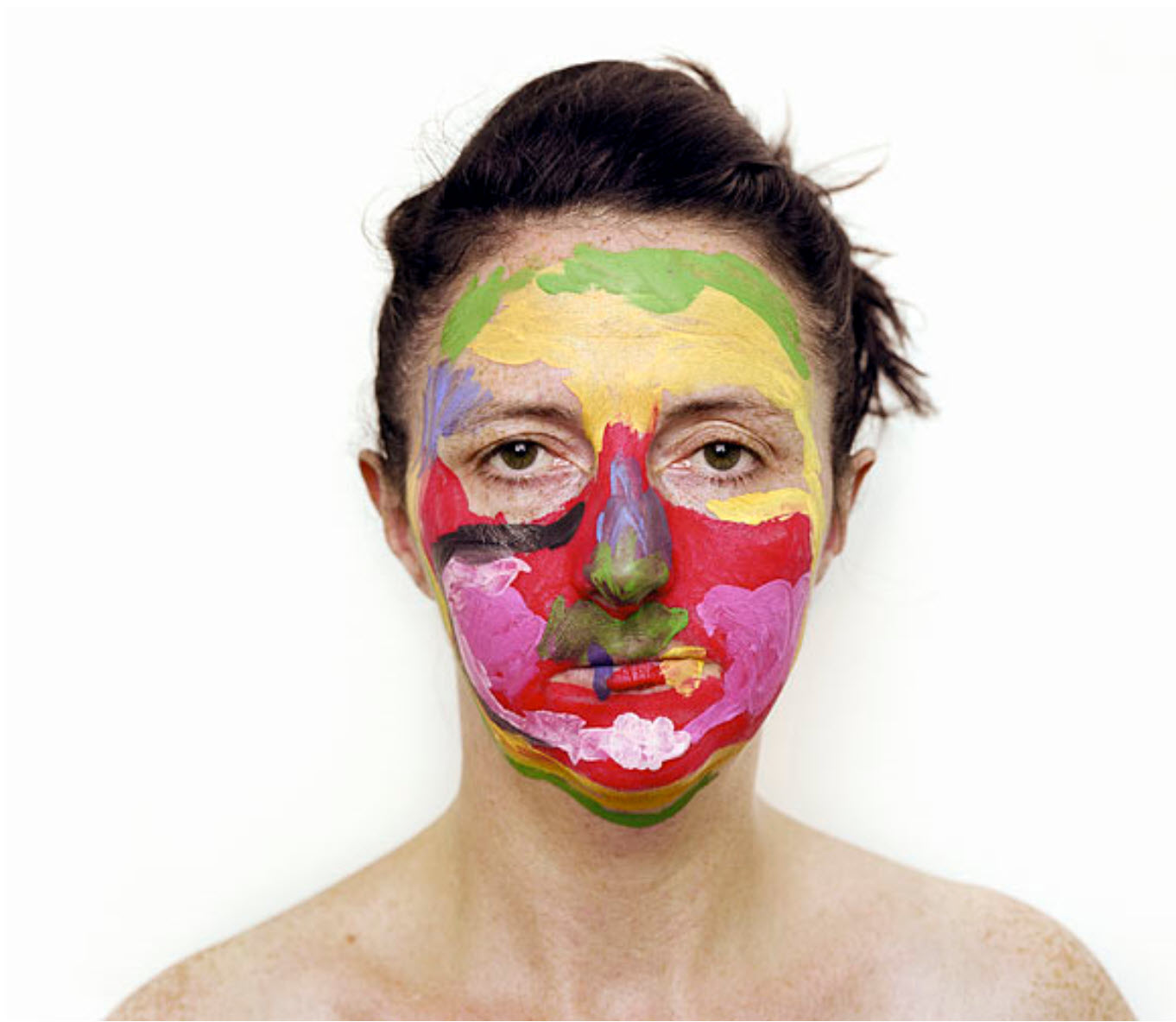
In this series Morrissey uses self-portraiture by allowing her daughter (then aged between 4 and 5 years – the age of the Failed Realist stage) to paint her face with whatever image she wished.  It started as a “rainy day” game with Morrissey painting her daughter’s face, but as her daughter became more skilled the roles reversed and she painted her mother’s face.

Morrissey Pocahontas
Pocahantas (2011) c Trish Morrissey

This series of photographs is not just a mother’s record of her daughter’s work and progress, but also a record of how a child at that age can interpret images from books, films, activities or experiences.

Seven Years

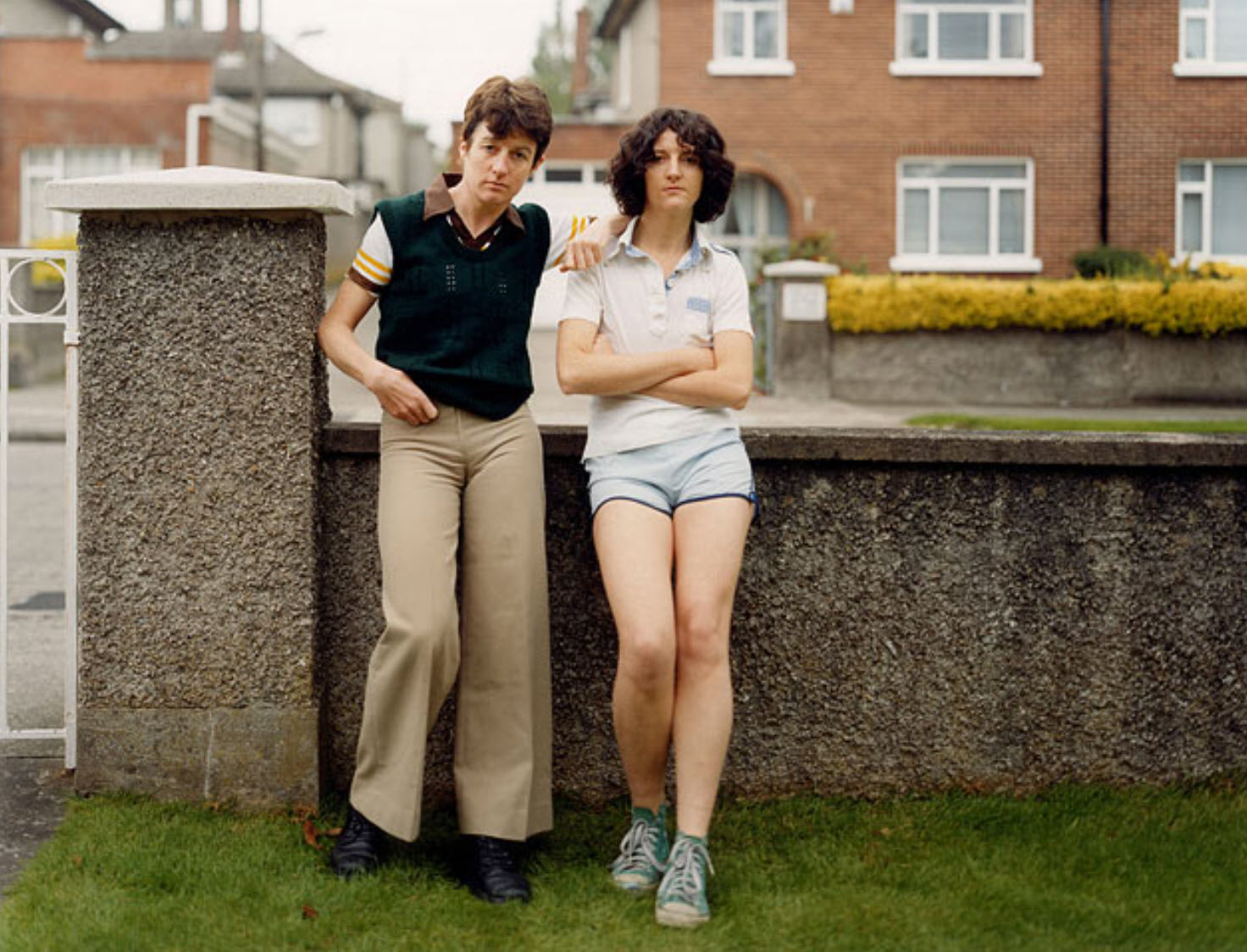
In this series Morrissey takes the opposite stance from her series Front.  Rather than infiltrating other families and groups of strangers, she creates a series of scenarios with her sister, seven years being the age gap between them.  They dress in clothes from the 70s and 80s, posing in such a way as to show the true sibling relationships and tensions that can exist in a family.  Although the photographs are all staged I think they represent family life as it is.

Morrissey siblings
May 1st, 1976 c Trish Morrissey


Part 3 · Research · Uncategorized

Duane Michals

Duane Michals is an American photographer who annotates much of his work and by combining text with images enhances their meaning.  In the example referred to in the course text: This Photograph is My Proof  (1974).

This Photo is my proof

The text indicates that the photograph was taken some time before the text was added.  But the question is raised as to whether she still loves him now, if not why did the relationship change?  Was it something which he did to affect the situation, or did she break it off.  Something far more tragic could have happened, perhaps she passed away and he just needed reassurance that they were happy when she was still alive.

The handwritten notes give the whole image a more intimate feel, but is not necessarily proof that the author of the note was also the subject of the photograph.  The photographer could have added this caption to create an ambiguity to it.

In his series Chance Meeting the same ambiguity has been embedded into the story. Do they actually know each other, or does the man with glasses think he knows the other man, but may not.

Chance Meeting

By adding narrative in this way, rather than explaining the meaning of a photograph, Michal gives the viewer the ability to make their own minds up.


Research · Uncategorized

Karen Knorr

Karen Knorr, a German photographer set out to create a series of images showing that even in the early 80s the English establishment was dominated by the male upper classes. Margaret Thatcher, despite being prime minister at the time and head of the Conservative party, was not allowed full membership of the Conservative Gentlemen’s Club.

I was astonished at this, I thought that by the ‘80s society had moved on and become less gender controlled, and less class conscious. The story is completed by Knorr’s captions. I was surprised that the subjects in some of the images appeared to be posing in a way expecting to be ridiculed, or perhaps they were unaware of the text she would be adding at a later date. In the image below I wonder whether this gentleman would have been so willing to allow her to take the photograph had he known what she would be adding.

Karen Knorr 1
c Karen Knorr


In the image below, the message is twofold: one that women are the inferior sex, preferring service to power, and, an implicit message, that the coloured gentlemen serving refreshments, in his role as waiter, was on the same level as women and not considered to be a “gentleman” at all.

Karen Knorr 2
c Karen Knorr

I felt that this series of images is in contrast to Kaylynn Deveney, in that she, the photographer, is removed from her subject emotionally. Those images in which she has included a “Gentleman”, none are looking at the camera, and look as if they posed.  Did she arrange the pose or did they pose themselves? She has introduced an element of humour by including text taken from speeches in parliament and news, and I think it is this text which brings home the attitudes and inequalities still prevalent in the ’80s.

Research · Uncategorized

Kaylynn Deveney

Kaylynn Deveney is photojournalist with the most empathetic approach towards her subjects. In The Day-to-Day Life of Albert Hastings she befriended an old man, and took a series of photographs of him towards the end of his life. He annotated the photographs himself, which made the images even more personal. At no time did Deveney judge or pass an opinion. She just recorded what she saw. A beautiful set of images portraying the life of a humble old man.

I then looked at her series: Edith and Len in which she befriended Edith and Leonard Crawshaw. Again, she used the same empathetic style, and became involved in the life of these two elderly residents of a carehome. She clearly built a bond between herself and these two people, and found the final goodbye as she was leaving to be very difficult and emotional.

Deveney’s work shows a caring person who wants to record the ordinary life of ordinary people. Two very moving sets of images. I feel very inspired by this work, and plan to try to create a similar body of work after the lockdown has been lifted.

Research · Uncategorized

Lee Miller

Lee Miller – A Life on the Front Line.

I have just watched this documentary film shown on BBC2, 2/5/2020.

Lee Miller was an extraordinary person and photographer, ahead of her time.  In a male dominated world she was able to stand out as a women, was the only female war photographer at the time, and yet retained her femininity throughout, having a number of affairs during her lifetime.

She started out as a model, appearing in American Vogue.  The story goes that she was discovered by Conde Naste as he scooped her up when she was almost run down by a car in New York.  Miller was used to be photographed as her father, Thoedore Miller, a keen amateur photographer, frequently took photographs of her, often in the nude.  Many of these were by today’s standards controversial, in what today would considered an inappropriate relationship between father and daughter.

It was photographer Edward Steichen who suggested she go to Paris to study photography with Man Ray  This resulted in Miller and Man Ray having an affair, but after a while because of Man Ray’s attempts at controlling her, the relationship broke down, her need for independence prevailed.

Miller then married an Egyptian businessman, and she moved to Egypt where she continued to take photographs. Despite the wealthy lifestyle she soon became disenchanted with life in Egypt.  Her husband offered to buy her a plane ticket to Paris so she could catch up with her old friends, but on the first evening in Paris she met an Englishman, Roland Penrose, and they started an affair.  She returned to Egypt but eventually returned to England to be with Penrose.  Before leaving Egypt her husband gave her a portfolio of shares so that she would never have to be dependent on anyone. He knew her need to be independent, a free spirit, so he provided the financial safety net, despite her leaving him for another man.

The next stage of her career was led by David Scherman, a war photographer, and he persuaded her to accompany him to Europe during the war.  Initially then went to St Malo.  This was a departure from fashion photography and she had  to learn to write text to accompany her photographs, something which she hadn’t done before.  Sherman and Miller visited Dachau Concentration Camp witnessing the liberation, before moving onto Munich.  She persuaded Vogue to publish a set of photographs, some showing horrific scenes of piles of bodies.

In Munich they visited Hitler’s home, and Scherman took the iconic photographs of Miller having a bath in Hitler’s bathroom, complete with her dirty boots on Hitler’s bathmat, a photograph of Hitler himself propped up next to Miller, and a look of defiance on Miller’s face. 

Lee Miller in Hitlers BathAt the end of the war, Miller returned to Roland Penrose, but nothing was ever the same again.  Penrose had another women in his life and at this point, the independent  free spirited Miller changed.  She had seen so much, and returning to normal life was not possible.  She was lost, became an alcoholic, and suffered depression.  Penrose tried moving her out to the country, but the lack of contact with anyone made her suffering greater.

When she died, her son, Antony Penrose, who knew nothing of his mother’s life and only saw the alcoholic, started to research her life.  He discovered all her photographs boxed up and hidden in a loft.  Realising he only knew a tiny part of his mother, he started to unravel her life.  She had been raped at the age of 7, causing her to be infected with VD, and then photographed by her father starting shortly after her rape and continuing into her teenage year, mostly in the nude.  She had been told to keep the rape a secret, and perhaps she adopted that strategy for all her other activities, her affairs, the war photography.  We will never know, but we have her son to thank for showing us the true Lee Miller.


Research · Uncategorized

Post Modern Narrative

The work of Sophie Calle and Sophie Rickett both reflect postmodernist approaches to the narrative although their work is very different.  However, the one aspect of their work is similar: the use of images, text, videos, and other media.

In her project “Take Care of Yourself”, Sophie Calle takes a letter received from her boyfriend in which he “dumps” her, and offers it to 107 women asking them to analyse the content according to their personal and professional interests.  As a result the letter was converted into music, displayed complete with handwritten annotations, projected onto images of faces, acted out, converted into a crossword.  The whole was an unstructured but meaningful display which reflects the postmodern approach to art.  She recorded an interview, currently available on the Tate.org website, explaining how the project developed.

https://www.tate.org.uk/art/artists/sophie-calle-2692/sophie-calle-dumped-email [accessed 3/4/2020]

Sophie Rickett developed her exhibition “Objects in the Field” following an encounter with a retired astronomer, Dr Roland Willstrop, while she was working at the Institute of Astronomy, University of Cambridge.  Dr Willstrop had previously developed a camera: The Three Mirror Telescope.  No longer in use, Rickett obtained a selection of now obsolete images, reprinted them herself, editing some in the process.  The result is a set of images and videos displayed in an unstructured way. The title of the exhibition, Objects in the Field refers to the atrological term for a light in the sky, object, and the sky itself, field.


Research · Uncategorized

The Commissar Vanishes

The Falsification of Photographs and Art in Stalin’s Russia

I recently came across this book by David King in my local library.  In it, David King shows a number of photographs and works of art which were edited to remove those who had fallen out of favour in the Stalinist era in Russia.

Book cover
Cover of the book “The Commissar Vanishes”


The Preface to the book is written by Stephen F Cohen, Professor of Politics and Russian Studies at Princetown University, at the time of publishing in 1997.

Under Stalin’s regime, which ruled the Soviet Union from 1929 to 1953, photographs lied.  In David King’s unique and revealing book, the same photographs, their original images restored, speak volumes of truth.

………Considering the five decades of official falsification and zealous concealment, David King’s book is heroic – the product of an immense, one-man archaeology.  His thirty-year unearthing of prefalsified Soviet photographs around the world has produced a legendary private collection …….

[Stephen F Cohen, New York, April 1997]

David King first became aware of this culture of falsifying photographs and art work, when in 1970, seventeen years after Stalin’s death, he visited the open sections of the photographic archives in Moscow.  When he asked about photographs showing Trotsky he generally received a reply:

“Why do you ask for Trotsky? Trotsky not important in Revolution.  Stalin Important.”

(King, 1997:12)

King said when he searched through the dark green metal storage boxes he discovered that although there were many mugshots in the section “T” there were none of Trotsky.

…They had completely wiped him out.  It was at this moment that I determined to start my collection.

(King, 1997:12)

During the following thirty years King created a collection of images showing the falsifications which took place during Stalin’s reign.  Some were airbrushed, some had parts of an image cut out, and in the case of artworks, had been recreated with a revised version in which some faces were removed or replaced.  In some cases a face has been blacked out and the book republished, as shown below.  (Presumably following the destruction of any previous versions of the book).

Isaac Zelensky
Image taken from “The Commissar Vanishes” showing Isaac Zelensky as he appeared in Alexander Rodchenko’s copy of “Ten Years of Uzbekistan”


This book contains many more examples of images being edited to remove those who have fallen out of favour.  In the context of this unit, I see these images as an example of “photographs can lie”.  This is not a case of a quick update for aesthetic reasons, but for  reasons of power and control during a particularly corrupt period in Russian history.

I found this book to be a very moving collection of images and accompanying stories.  In my view David King has highlighted a serious issue which could easily be repeated in the future if corrupt power is able to take control in this way. Modern technology makes it easier, but the example of the Russian regime shows that technology as we know it today is not necessary if the desire is there to hide anything which is percieved to be in contravention of the State’s aim.

Bibliography

King, D. (1997) The commissar vanishes: The falsification of photographs and art in Stalin’s Russia. New York: Metropolitan Books.


Research

Judith Williamson

AdvertJudith Williamson’s article in Source magazine regarding an advertisement for an Apple ipad opened up a whole new way of looking at advertisements for me.  I initially saw the picture of a girl lying in bed looking at an ipad.  But when I read Judith’s article, I could see that the way the lighting was set, the fact that it was difficult to tell the girl’s ethnicity, thus indicating a multi national product, and the words “Designed by Apple in California” all have a bearing on the way this photograph is perceived.  When I read on, according to Williamson, the actual item would have been manufactured in a “sweat shop” in China so it is obvious why Apple has indicated its design was in California, with no mention of the manufacturing process or location.

So looking at this photograph, the narrative may be a young girl lying in bed looking at her ipad, with the light shining down onto her in an ethereal way.  But the context is very different, particularly when investating the production of the ipad, and the conditions of those actually producing it.

I will certainly be viewing advertisements in a different way in future, analysing the narrative and context to give the complete “picture”.  I will also read more of Judith Wliiamson’s articles.