This was a difficult exercise because I had a very varied childhood, partly because I had chronic asthma, so was rarely at school, but also because my father’s job took him to different places. We moved around a lot, I moved schools, made different friends and felt I didn’t really belong anywhere. But there was one constant throughout my childhood. Our horses. My two sisters and I were bought our first pony when I was 7 years old. Of course, one pony was not enough for three active girls and we soon had one each. I competed in all the local shows, and was an active member of the Pony Club. I remember that during those years, despite my asthma, I was always felt fit and well when around the ponies.
I don’t have any photographs of myself during that time as they are all packed away in a box my sister’s loft 100 miles away. And it is not something which could be recreated easily without access to horses – which I don’t have.
When I became a parent, it turned out my daughter had the same interest in horses as me and I was able to relive my childhood through her. I bought her a pony, went to all the shows, attended Pony Club events, and generally enjoyed recreating the life I had had all those years ago.
I decided to recreate my childhood memories by using a photograph of my daughter aged 10 years competing at a local cross country event, with me taking a photograph of her as my mother would have done when I was 10 years old. I used Photoshop to create the photograph, adding myself to the image, and although I have achieved what I set out to do, it is not perfect. However, it is a representation of my childhood – my daughter as me, and myself as my mother.
Rebecca competing at the Blackhorse Cross Country Event aged 10 years.
This exercise brought back memories of my childhood, the excitement, the nerves, the disappointment or elation depending on the outcome of a competition. It also brought back memories of the time spent with my daughter and her pony. She is now 36, and those years have passed, but we both have strong memories of those times.
I think anyone viewing this photograph would understand the subject matter, but would need to read the narrative to understand how it is a representation of my childhood.
I decided to create a visual diary for this assignment, as I had already started writing a daily diary at the beginning of March. I have not included every diary entry, but a selection of entries with images to illustrate and support the entries.
I wanted the text to work with the images to give more meaning and context. I looked at the work of Duane Micals, who by adding text, often created a greater ambiguity. He created more questions than answers, leaving the viewer to decide on the content. I wanted the photographs to create ambiguity and the text to tell the story.
Kaylynn Deveney allowed her subject, Albert Hastings to create his own captions himself. This makes the images more personal to him. Had Deveney created the wording herself the series would have been from her perspective, not his.
I was inspired by Nigel Shafran’s approach of photographing the mundane and I tried to create a visual diary in the same way he created the series Washing-up: not staged, just recording what he saw.
I researched the work of these three photographers more fully in my blog, see Course Work, Part 3.
I decided to use my Samsung S9 Camera phone. I felt this would be more intimate than a bulky DSLR camera, and readily available. I also decided to use the “square” option (1 x 1 ratio). I started the project creating images using 2 x 3 ratio but I found the resulting images would have had to be cropped considerably to focus on the subject, and the resulting cropped version turned out to be square.
None of the photographs were staged, any surrounding “clutter” was left in situ as part of daily living in a small space.
Below is an extract from some of the entries.
Monday 9th March
Our 70ft narrowboat went into the dry dock today for a complete repaint, and we moved onto a smaller boat lent to us by a friend, leaving most of our possessions behind. It is a holiday boat and therefore doesn’t have all the facilities ours has. But this won’t be a problem as it is only for 6 weeks, and I plan to spend time with my grandchildren anyway, so won’t be there much of the time.
Note: It was the first day of what has turned out to be a time of more stress than I ever imaged.
Wednesday 11th March
The borrowed boat has been neglected, over-run with mice, and generally in a sorry state. I set about cleaning it, and the whole process overwhelmed me, especially as we had borrowed it before, and we had had to clean it thoroughly then. I first will have to deal with the infestation before attempting to clean up. And then every cupboard will have to be cleared out and cleaned.
Note: my diary contained a longer entry than this, and looking back I realized I was emotionally at rock bottom on that day. I will not reproduce all the words from that diary entry, as some are quite colourful, but it shocked me when I read it later. I don’t feel ready to share all of the notes.
Tuesday 17th March
I feel great empathy with Anna Fox and her cockroaches as I dealt with the mice infestation. I didn’t write such a detailed diary at the time, nor take photographs as she did, but my battle with the mice was similar. They seemed to invade the whole boat. But I think I have got them all – poisoned them. Not very environmentally friendly, but I just have to get rid of them.
Every cupboard has to be cleaned thoroughly, all the contents washed, and I filled a full black sack with food and rubbish to be thrown away. They had invaded my life. I feel dirty.
Monday 23rd March
Lockdown began. The staff at the marina were sent off on furlough today, which means that the marina owner will be completing the work on our boat on his own. Not the 6 weeks originally planned.
Tuesday 24th March
Neil, a key worker, was told he has to work from home. This means that from 8.00am until 5.00pm he has his pc and 2 screens set up on the only table in the boat, located centrally, and is on the phone for most of the day. I’m finding this increasingly difficult, as there is nowhere to work, escape or study. I creep around the boat, or perch on a chair in the corner not knowing what to do.
All of these events have compressed my life into one of just existing, and I decide the only way to deal with it is to create a photographic diary. I want to use it to express how I feel, and to be able to look back and understand what happened during that time.
Diary of Lockdown AEH49
Tuesday 31st March
My father-in-law had a fall, and was taken to hospital with a broken femur. No visitors allowed so we have to just wait and see.
Saturday 4th April
Following surgery on Wednesday 1 April, he deteriorated and never fully recovered. He passed away on Saturday afternoon. We are in complete shock. Last Monday we were chatting to a fit 87 year old man, and by Saturday he has gone. As Neil is the executor of his will, not only is he grieving for his father but attempting to sort out his affairs during lockdown.
Monday 6th April
Neil collected all the paperwork from his dad’s flat. We now have 4 large bags of paperwork to be sorted, taking up precious space in an already small home. Just 4 bags representing the life of one man.
Diary of Lockdown AEH38
Tuesday 7th April
More changes to get used to. No washing machine on this boat and no facilities available for drying it either. So off to the launderette. The local launderette has changed its opening times, and also it only allows service washes. I have to knock on the door, hand my bag of washing in to the attendant, and then leave. I feel uncomfortable doing this. Someone else handling my dirty washing?
Diary of Lockdown AEH50
I arrive to collect the washing later that day and find it all done and beautifully folded. A luxury after all!
Wednesday 8th April
Another change: the toilet arrangements. We have a pump out system on our boat so a trip to the marina service point is all that’s needed to empty the holding tank. Now we have to use a “Porta Potti”, which involves manually emptying a very small cassette tank into the nearest Sanitary Station twice a week.
Diary of Lockdown AEH48
Ours is a 10 minute trip in the car. Emptying the tank a simple process, but one I’m not used to. The cassette is heavy. I try to get out of it as often as possible, leaving it to Neil. But today I have to do it. The indicator on the front has changed from green to red, meaning it is full. And we don’t have a spare cassette. Boat life is basic at times, but we have to just accept it.
Tuesday 14th April
I really need to continue working on my course to get through the work. Where is the best place on the boat?
Perhaps on the chair where I have breakfast. I try to put the laptop on the stool, but there’s nowhere for my books and files.
Diary of Lockdown AEH22
Where else can I go to study? It’s too cold to go outside on the decking, the only other place away from Neil is the bedroom. Perhaps this will work. Not very comfortable, and the light is useless. No windows near the head of the bed, and 12v overhead “reading lights” shed no light at all.
Diary of Lockdown AEH05
Friday 17th April
My back is aching from sitting on the bed trying to do my research. Perhaps I’ll try sitting outside. Thankfully the wifi signal extends to our decking. It’s difficult to see the screen in this light. Despite the cold, the sun is shining.
Diary of Lockdown AEH16
No. Not warm enough even with woolly jumpers and fingerless gloves. Back to the bedroom for the time being.
Diary of Lockdown AEH40
Wednesday 22nd April
Neil has an appointment with the doctor, perhaps I can use the table while he has gone. Forgot to ask him to move his kit, and I don’t want to touch it in case I disconnect something I shouldn’t! So back to the bedroom again. I must do a quick edit in Photoshop for this image for privacy reasons as he left the screens on. And he is supposed to work in a secure environment. I’m not supposed to look at the screens, but its difficult given the space available. I try averting my eyes, without success. But along with listening to his phone calls, I have to ignore it and forget.
Diary of Lockdown AEH54
Wednesday 29th April
My birthday today, a big zero day. All the plans to celebrate with the family have been put on hold. The only excitement today is trying out the slow cooker which used to belong to my father-in-law. Something to remember him by. I manage to cook a delicious lamb casserole so it was worth it. And we will celebrate my birthday when all this madness is over.
Diary of Lockdown AEH42
Thursday 7th May
Thank goodness, I don’t have to heave that tank into the car and off to the Sanitary Station today, Neil has offered to do it. He managed to tear himself away from the phone and computer, and has just set off. He’s taken all the recycling bags with him as well.
Diary of Lockdown AEH39
Saturday 16th May
There is light at the end of the tunnel. Our beautiful newly painted boat is moved out of the dry dock and moored alongside our temporary home.
Not quite finished yet, so we can’t move in properly, but I can start the clean up inside, vacuum the sand which found its way in whilst the exterior was being sand blasted ready for the repaint. Hard work ahead, but positive.
Diary of Lockdown AEH52
Maybe I will survive the lockdown, even with Neil working from home. With other restrictions starting to lift, life can only get better. And I will have a space in which to study, away from Neil. I can escape to next door. Thankfully the wifi works if I put the box next to the window.
And the weather has warmed up so if all else fails – I can sit on the decking!
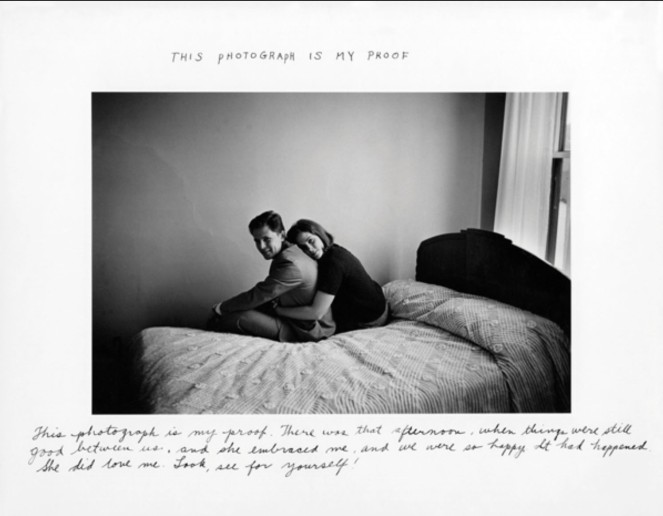
Duane Michals is an American photographer who annotates much of his work and by combining text with images enhances their meaning. In the example referred to in the course text: This Photograph is My Proof (1974).
The text indicates that the photograph was taken some time before the text was added. But the question is raised as to whether she still loves him now, if not why did the relationship change? Was it something which he did to affect the situation, or did she break it off. Something far more tragic could have happened, perhaps she passed away and he just needed reassurance that they were happy when she was still alive.
The handwritten notes give the whole image a more intimate feel, but is not necessarily proof that the author of the note was also the subject of the photograph. The photographer could have added this caption to create an ambiguity to it.
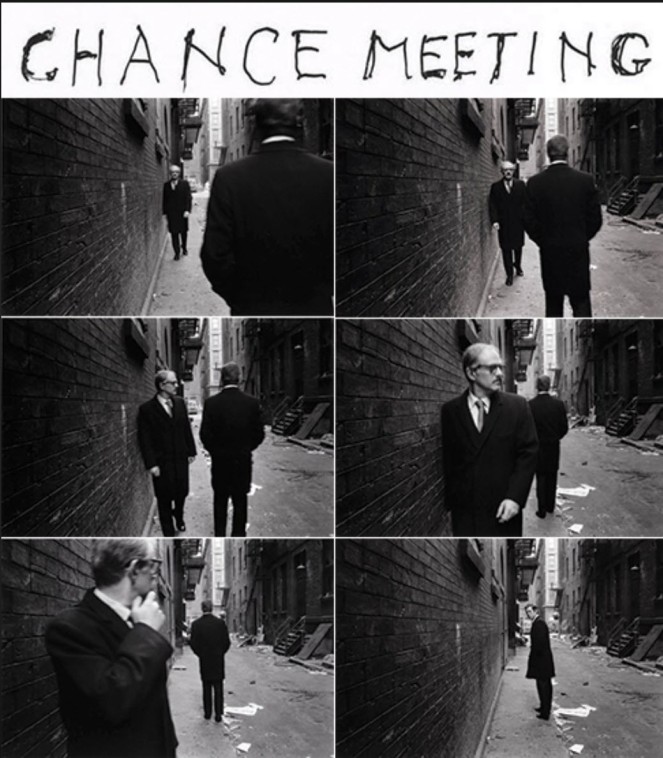
In his series Chance Meeting the same ambiguity has been embedded into the story. Do they actually know each other, or does the man with glasses think he knows the other man, but may not.
By adding narrative in this way, rather than explaining the meaning of a photograph, Michal gives the viewer the ability to make their own minds up.
Nigel Shafran started his career as a fashion but now focusses on photographing the mundane, and often unnoticed people and parts of society. I was fascinated by his series Bookshelves, as I felt that each image reflected the character of the owner of that bookshelf. I would love to have talked to the owners of those bookshelves to see how my interpretation of the images was in line with the owners’ personality.
In his series Washing Up, Shafran created a series of images of the kitchen sink and draining board after the washing up had been done, but with different items on the draining board and different captions describing each scenario.
I addressed the questions in the exercise as follows:
Did it surprise you that this was taken by a man? Why?
No, I was not surprised. In our culture it is acceptable for both men and women to do the washing up, and he was recording an activity that he would probably have participated in. Given his style of photography, photographing the mundane, it seems to fit with this series.
In your opinion does gender contribute to the creation of an image?
I do think gender can effect the creation of an image, but I believe it depends on the subject and scenario rather than the abilities of the photographer. In some situations a female photographer is more likely to be accepted or even unnoticed. For example, Doreen Spooner, the first female Fleet Street photographer, was able to take a photograph of Christine Keeler and Mandy Rice-Davies taking a break from the Old Bailey trial of Stephen Ward in July 1963. They were sitting near the ladies toilets, and she was able to hide in the ladies and take the photograph unnoticed. A male photographer would not have had such an opportunity.
Christine Keeler and Mandy Rice-Davies were prime press targets during the Old Bailey trial of society osteopath Stephen Ward in July 1963
Spooner was able to snap Keeler and Rice-Davies at a pub in Holborn by hiding in the ladies’ loo. ‘I put the door ajar and stuck the camera through it,’ she recalled. ‘My heart was in my mouth as it was very dingy in there… I developed them and what a relief when I saw they’d come out.’ The shot was splashed on the front page.
What does this series achieve by not including people?
In his series Washing up, Shafran achieves anonymity by not including people. Most people at some time in their lives will have to do washing up in some form or other, regardless of their culture, ethnicity or gender. By not including people, he has reinforced this as a multicultural, multi ethnic and non gender specific activity.
Do you regard them as interesting “still life” compositions?
I think that had Shafran omitted the captions, they would be less interesting, but by adding the captions he has brought the compositions to life. It makes them intimate and personal. Unfortunately I was unable to find the whole set of images where the captions were included, but the example shown in the course text does show how the captions describe the scenarios.
Karen Knorr, a German photographer set out to create a series of images showing that even in the early 80s the English establishment was dominated by the male upper classes. Margaret Thatcher, despite being prime minister at the time and head of the Conservative party, was not allowed full membership of the Conservative Gentlemen’s Club.
I was astonished at this, I thought that by the ‘80s society had moved on and become less gender controlled, and less class conscious. The story is completed by Knorr’s captions. I was surprised that the subjects in some of the images appeared to be posing in a way expecting to be ridiculed, or perhaps they were unaware of the text she would be adding at a later date. In the image below I wonder whether this gentleman would have been so willing to allow her to take the photograph had he known what she would be adding.
c Karen Knorr
In the image below, the message is twofold: one that women are the inferior sex, preferring service to power, and, an implicit message, that the coloured gentlemen serving refreshments, in his role as waiter, was on the same level as women and not considered to be a “gentleman” at all.
c Karen Knorr
I felt that this series of images is in contrast to Kaylynn Deveney, in that she, the photographer, is removed from her subject emotionally. Those images in which she has included a “Gentleman”, none are looking at the camera, and look as if they posed. Did she arrange the pose or did they pose themselves? She has introduced an element of humour by including text taken from speeches in parliament and news, and I think it is this text which brings home the attitudes and inequalities still prevalent in the ’80s.
Kaylynn Deveney is photojournalist with the most empathetic approach towards her subjects. In The Day-to-Day Life of Albert Hastings she befriended an old man, and took a series of photographs of him towards the end of his life. He annotated the photographs himself, which made the images even more personal. At no time did Deveney judge or pass an opinion. She just recorded what she saw. A beautiful set of images portraying the life of a humble old man.
I then looked at her series: Edith and Len in which she befriended Edith and Leonard Crawshaw. Again, she used the same empathetic style, and became involved in the life of these two elderly residents of a carehome. She clearly built a bond between herself and these two people, and found the final goodbye as she was leaving to be very difficult and emotional.
Deveney’s work shows a caring person who wants to record the ordinary life of ordinary people. Two very moving sets of images. I feel very inspired by this work, and plan to try to create a similar body of work after the lockdown has been lifted.
I have just watched this documentary film shown on BBC2, 2/5/2020.
Lee Miller was an extraordinary person and photographer, ahead of her time. In a male dominated world she was able to stand out as a women, was the only female war photographer at the time, and yet retained her femininity throughout, having a number of affairs during her lifetime.
She started out as a model, appearing in American Vogue. The story goes that she was discovered by Conde Naste as he scooped her up when she was almost run down by a car in New York. Miller was used to be photographed as her father, Thoedore Miller, a keen amateur photographer, frequently took photographs of her, often in the nude. Many of these were by today’s standards controversial, in what today would considered an inappropriate relationship between father and daughter.
It was photographer Edward Steichen who suggested she go to Paris to study photography with Man Ray This resulted in Miller and Man Ray having an affair, but after a while because of Man Ray’s attempts at controlling her, the relationship broke down, her need for independence prevailed.
Miller then married an Egyptian businessman, and she moved to Egypt where she continued to take photographs. Despite the wealthy lifestyle she soon became disenchanted with life in Egypt. Her husband offered to buy her a plane ticket to Paris so she could catch up with her old friends, but on the first evening in Paris she met an Englishman, Roland Penrose, and they started an affair. She returned to Egypt but eventually returned to England to be with Penrose. Before leaving Egypt her husband gave her a portfolio of shares so that she would never have to be dependent on anyone. He knew her need to be independent, a free spirit, so he provided the financial safety net, despite her leaving him for another man.
The next stage of her career was led by David Scherman, a war photographer, and he persuaded her to accompany him to Europe during the war. Initially then went to St Malo. This was a departure from fashion photography and she had to learn to write text to accompany her photographs, something which she hadn’t done before. Sherman and Miller visited Dachau Concentration Camp witnessing the liberation, before moving onto Munich. She persuaded Vogue to publish a set of photographs, some showing horrific scenes of piles of bodies.
In Munich they visited Hitler’s home, and Scherman took the iconic photographs of Miller having a bath in Hitler’s bathroom, complete with her dirty boots on Hitler’s bathmat, a photograph of Hitler himself propped up next to Miller, and a look of defiance on Miller’s face.
At the end of the war, Miller returned to Roland Penrose, but nothing was ever the same again. Penrose had another women in his life and at this point, the independent free spirited Miller changed. She had seen so much, and returning to normal life was not possible. She was lost, became an alcoholic, and suffered depression. Penrose tried moving her out to the country, but the lack of contact with anyone made her suffering greater.
When she died, her son, Antony Penrose, who knew nothing of his mother’s life and only saw the alcoholic, started to research her life. He discovered all her photographs boxed up and hidden in a loft. Realising he only knew a tiny part of his mother, he started to unravel her life. She had been raped at the age of 7, causing her to be infected with VD, and then photographed by her father starting shortly after her rape and continuing into her teenage year, mostly in the nude. She had been told to keep the rape a secret, and perhaps she adopted that strategy for all her other activities, her affairs, the war photography. We will never know, but we have her son to thank for showing us the true Lee Miller.
I looked at the work of three photographers who use autobiographical self-portraiture in their work: Francesca Woodman, Elina Brotherus and Gillian Wearing.
Francesca Woodman
Francesca Woodman was a troubled person – she sadly committed suicide at the age of just 22 years. She was a prolific photographer and her family now have some 800 images which she took during her short life. It is a tragedy that anyone should be so troubled that they would take their own life and I felt very sad looking at the images in the series Space2. And ironically, her work only became well known and accepted after her death.
I knew she had taken her life before I looked at her series Space2, and I’m not sure I would have grasped that she was so troubled just by looking at the images. I think the narrative is part of these images, and helps me to understand why she created them.
Anyone suffering from depression so severely is, by the very nature of the illness, totally self centred, therefore in the case of Woodman, I do not consider these images are created as a result of self indulgence or narcissistic tendencies. It is likely that her thoughts were confined to the boundaries of her depression, and in the series Space2 she was expressing those thoughts. The images in which she is almost not there, a ghost image, or a blur, indicate to me that she felt an outsider, a misfit, not part of conventional society. Hiding behind wall paper, posing naked, tells me that she was expressing her feelings of vulnerability.
I don’t believe think she was addressing wider issues because her depression would probably have prevented her from thinking about anything outside her immediate world.
Elina Brotherus
In her series Annonciation, Elina Brotherus used photography to express her sadness of her failed attempts at IVF, and I think that unlike Woodman her aim was to tell others of her experiences and sadness. In an interview quoted in the course text she says she prefers to tell her story through photographs as she is still too sad to give interviews. I looked through her series as she progresses through each attempt at IVF, and felt she had stripped her inner feelings from her body as she worked through the photographic story. I felt that the images in which she is naked show her as losing everything, even the protection of her clothes.
This is not a journey in the world of narcissim or self-indulgence, but the telling of a story. She says that so often we see the success stories surrounding IVF but not the sadness surrounding failed attempts. 3 particular images caught my attention:
Annonciation 14: she is sitting in a bathroom with a figure in the background. She has her back to this person, and is alone in her grief. Who is that person, her partner, a doctor? We will never know.
Annonciation 21, New York. This is the only image, apart from Annonciation 14, which includes a male figure, presumably her partner. In all other images she is alone, showing just how failed IVF can become all consuming to the point that a loving relationship becomes secondary to the task in hand.
Annonciation 27: this is the only image where she is smiling, as though she has a secret but can’t tell anyone yet. Did she think this time the treatment has worked? But we know it didn’t because the series progresses with further failures.
A desperately sad set of images but with an important message: IVF is not always successful and these stories are often left untold.
Brotherus went on to create a series Carpe-Fucking-Diem in which she starts moving on and realizing that she will remain childless, but that the world goes on as normal, regardless. She photographed herself in ordinary situations, and in some cases, with humour that was not seen in Annonciation. Some of these images were taken during her IVF treatment but mostly after she had come to terms with failed IVF.
A man, presumably her partner, appears in several photographs, which indicated to me that their relationship had changed, he was no longer excluded from her world of grief. I felt that she was using the process of creating this series as therapy and closure.
Gillian Wearing
Wearing followed a number of photographers in focusing on family as well as self-portrait, combining the two. She set out to create a series of images by creating masks resembling members of her family, with the eyes cut out, and then photographed herself wearing them. She was inspired by the work of Claude Cahun, and her work was displayed alongside Cahun’s work at the National Portrait Gallery in 2017. Cahun like Wearing created images using masks, using them in self-portraiture.
This departure from the usual “selfie” indicates to me that Wearing was not doing this for narcissistic reasons but to show that roles in families are interchangeable, everyone can put on the persona of another member of the family. I felt that the process of making the masks was as important to Wearing as taking the photographs of the end product.
The three photographers shown here, although all working in self-portraiture, have different ways of working and different reasons for producing this type of image.
All the images were taken on the same day, in early morning sunshine. There was no opportunity to take any images later in the day, or on another day because CRT had issued the directive of not using towpaths unless accessing a moored boat. As I moor in a marina which is currently locked down, I cannot justify walking along a towpath. The marina owner is adamant that all those living the marina must adhere to those guidelines, even though we often see members of the public walking, cycling and fishing. So further photography along the towpath is not possible at the moment.
Unfortunately, the position of the camera affected the exposure. I should have used the exposure compensation to change the exposure with the different lighting situations, and possibly changed the white balance from sunny to cloudy depending on the position of the sun. I need to explore the technical side of taking landscape photographs, being more mindful of the ambient light, the position of the sun and the time of day.
My tutor pointed out the similarity in the image of the canal side pub, deserted half way through a major refurbishment project, and Walker Evans’ photographs of the 1930s depression while working for the FSA. His photographs illustrated the effects of the depression on the poor, showing images of the environment, deserted buildings and farmland. My image of the canal side pub shows how the lockdown has affected many businesses. At the moment the building is surrounded by security fencing and any work carried out will be done in secret. The bars of the fencing creating a prison. We (the local boating population) wonder whether the work will ever be completed, and the building reopen as a pub.
Research
Tutor feedback: item 2
Photographic strategy: my intention was to create a series of images showing the canal and local businesses and the effect the lockdown is having on these areas. I realise now that I should have included images busy waterways so the viewer could make the comparison between then and now.
A typical day on the Napton Flight.
Tutor feedback: item 3
My tutor suggested that I explore the theme of the aftermath school, including the work of Joel Sternfeld and Chloe Dewe Mathews. I had referenced Hurn’s work, suggesting this was an essay rather than a story, but my tutor felt that there was more narrative to be explored: the aftermath of the event. Both these photographers had produced work which showed the aftermath of events.
Jeol Sternfeld spent time photographing life in America and produced a set of images portraying life in the past and the possible future, publishing the in a book: American Prospects. In his series The High Line, he discovered a disused railway line which had been built in the 20s to transport freight, now no longer used. It runs through Manhatten, largely unnoticed. He took a series of photographs throughout the seasons showing how the railway is transformed with each change of the season. He said this discovery was one of the most exiting pieces of work and can be seen discussing the series of photographs on YouTube:
Chloe Dewe Mathews, also a documentary photographer, spent time investigating and photographing the locations in fields of Belgium and France where many British, French and Belgian solders had been executed for cowardice and during World War I. She took the photographs at dawn as this was usually the time a soldier would be executed and the resulting collection was exhibited as “Shot at Dawn”.
It’s almost the opposite of war photography. So, instead of the photographer bearing witness, it is the landscape that has witnessed the event and I who am having to go into that landscape in the hope of finding anything tangibly connected to the event.
Without the narrative associated with each image in “Shot at Dawn” (the name, time and date of each execution at that location) the images could be interpreted as just a series of landscape photographs. The viewer would not see the real horrors and injustices which took place at those locations, all evidence has been erased over time. By creating this series and including the narrative, as she has done, she will inevitably get people thinking and talking about subjects that may take them out of their comfort zone. It certainly did that for me.
At a later date I plan to take the subject further, to investigate the aftermath of this period of lockdown, the effects on the canal trade, the marinas, boat builders, canalside tradespeople, canalside pubs. The links are endless, and no doubt there will be many social and financial casualties when this crisis is over.




 Context and Narrative